
A university EPG is attached to a vCenter VMM domain with resolution immediacy set to on-demand. The ESXi host is already on the distributed switch. The new virtual machine is powered off and is not in the EPG port group, and the leaf has not programmed the encapsulation. What causes that programming?
Select an answer to reveal the explanation.
Short Explanation
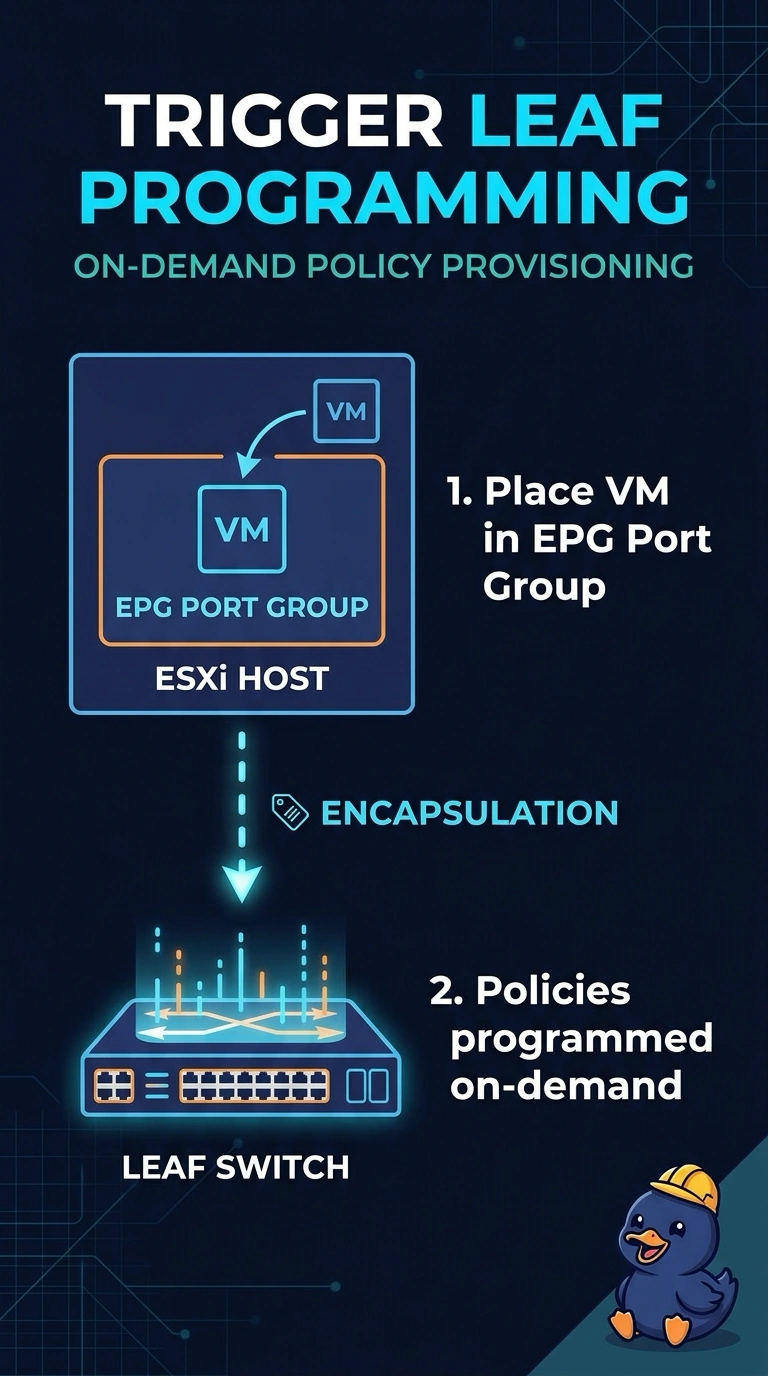
The dock will not stage your shipment for a truck that has not pulled into the bay. On-demand resolution pushes the encapsulation when a virtual machine is placed in the port group, and this VM is not in it.
Full Explanation
With on-demand resolution immediacy, the APIC pushes the VLAN or VXLAN binding, contracts, and filters to the leaf when the host is attached to the distributed switch and a virtual machine is placed in the EPG port group. The host is already on the switch. The missing event is the VM joining that port group. Putting the VM there is what causes the programming. The infrastructure VLAN is the fabric VLAN. Copying it into a tenant pool does not deploy an EPG encapsulation. Removing the AAEP from the policy group takes the domain off the physical ports and makes this worse. Hardware proxy changes unknown-unicast forwarding for a bridge domain. It does not push a VMM encapsulation onto a leaf. Caveat: the leaf also needs CDP or LLDP between the host and the leaf, or on-demand and immediate both remove the policy when that neighborship disappears. Immediate resolution would have programmed the leaf when the host joined the distributed switch, even with no VM in the port group. Operational check: place the VM in the port group and confirm the encapsulation appears on the leaf port toward that host.