
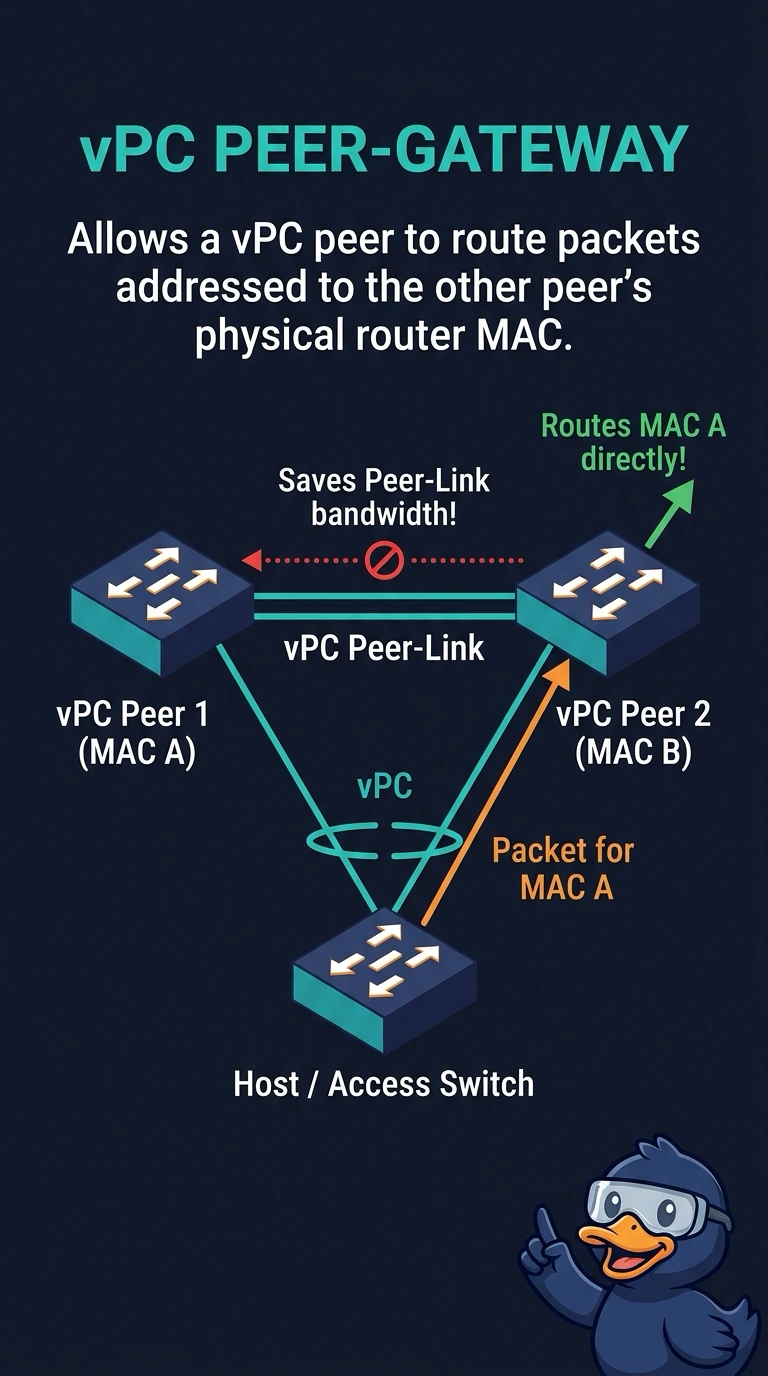
A national retailer's storage array sends replies to one vPC peer's physical router MAC, and those frames arrive on the other peer, which does not route them. Which vPC feature lets the receiving peer forward that traffic?
Select an answer to reveal the explanation.
Short Explanation
The package was addressed to one front door and dropped at the other door, which refused to open it. You enable peer-gateway so the receiving vPC peer will route packets aimed at the other peer's router MAC. Making the pair look like one spanning-tree root does not teach that door to accept the package.
Full Explanation
Some attached devices reply to a router at its physical MAC rather than at the virtual gateway MAC. In a vPC, that frame can hash to the peer that does not own the MAC. Without peer-gateway, the receiving peer does not route packets addressed to its partner's router MAC, which is the retailer's symptom. Peer-gateway lets either peer forward those packets. Peer-switch coordinates spanning tree so both peers present one root. It does not make a peer route frames that are addressed to the other peer's router MAC. The peer-keepalive link detects whether the peer is alive. It does not elect a forwarder for the partner's MAC, and it carries no user traffic. ARP synchronization copies ARP entries between the peers so a failover does not have to relearn them. It does not rewrite the array's frames onto the virtual gateway MAC, and the frames in this incident are already using a physical router MAC. Caveat: peer-gateway does not fix a peer-link failure, and the peers still need a working peer-link for the vPC to be in the normal forwarding state. Operational check: enable peer-gateway on the pair, send a reply to one peer's physical router MAC onto the other peer, and confirm that peer routes it.