
A game studio and three partner studios share one cloud that is closed to the general public and is not owned by only one of the studios. Which NIST 800-145 deployment model is that shared cloud?
Select an answer to reveal the explanation.
Short Explanation
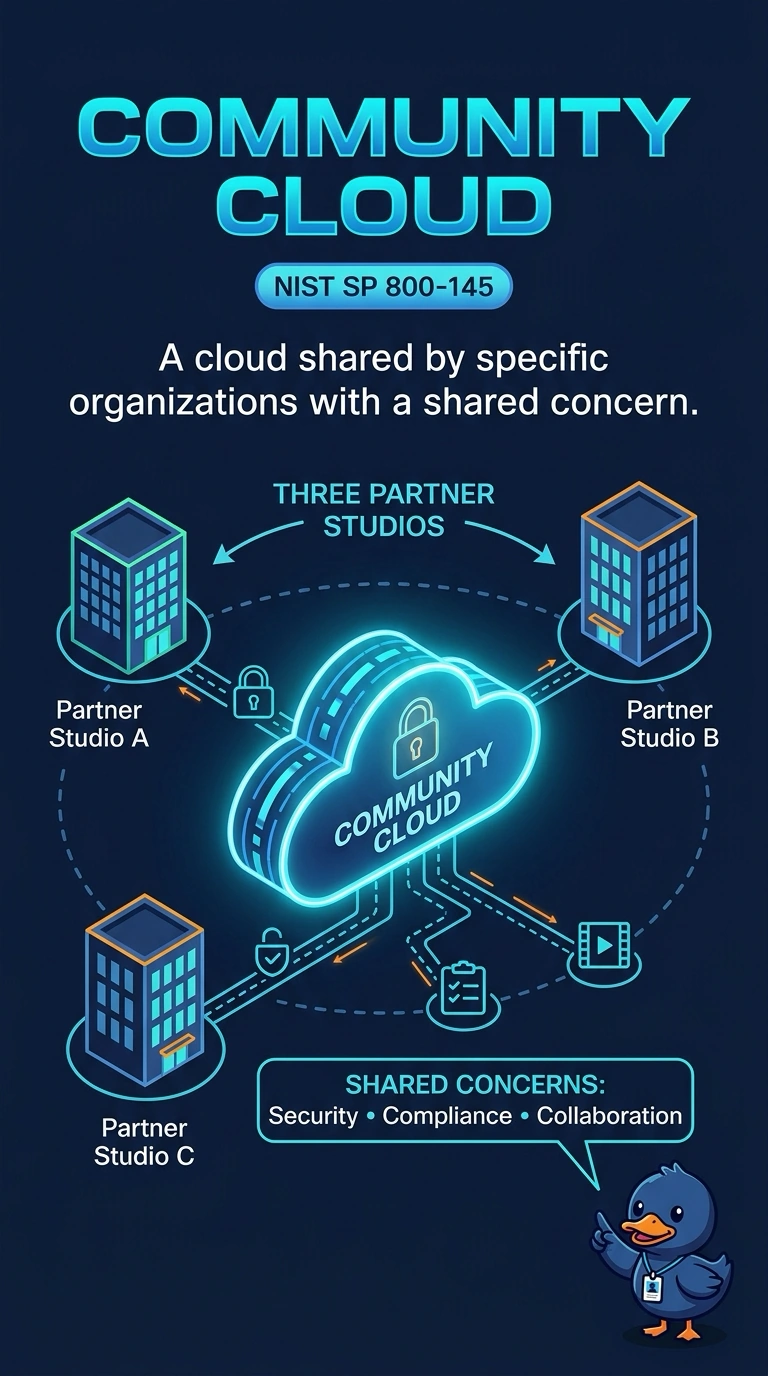
Picture a clubhouse that several teams share and the rest of the town cannot join. You call that a community cloud, because a defined group of organizations with a common concern uses it together. It is not a public cloud just because more than one company shows up, and it is not four clouds glued together.
Full Explanation
NIST 800-145 names four deployment models. A community cloud is provisioned for use by a specific community of organizations that share a concern, and it may be owned by one of them or by a third party. The studio and its three partners, on one cloud that is not open to the public and not owned by a single studio, match that model. A public cloud is open to the general public. Counting more than one tenant is not what makes a cloud public. A private cloud is dedicated to a single organization. Closing the doors to outsiders does not make a four-studio cloud private, because the users are not one organization. A hybrid cloud is a composition of two or more distinct cloud infrastructures bound by technology that lets data and applications move between them. Four studios on one shared cloud are not four clouds, so the deployment is not hybrid. Caveat: the service model is a separate choice, and this same community cloud could still be IaaS, PaaS, or SaaS depending on what the studios manage. Operational check: document who is allowed to subscribe, confirm the cloud is not offered to the public, and confirm it is one deployment rather than separate private clouds linked together.