
A game studio runs PIM sparse mode. Receivers send joins, the source is sending, and the unicast route to the source matches the interface where multicast would arrive. No rendezvous point is defined for the group. What is missing?
Select an answer to reveal the explanation.
Short Explanation
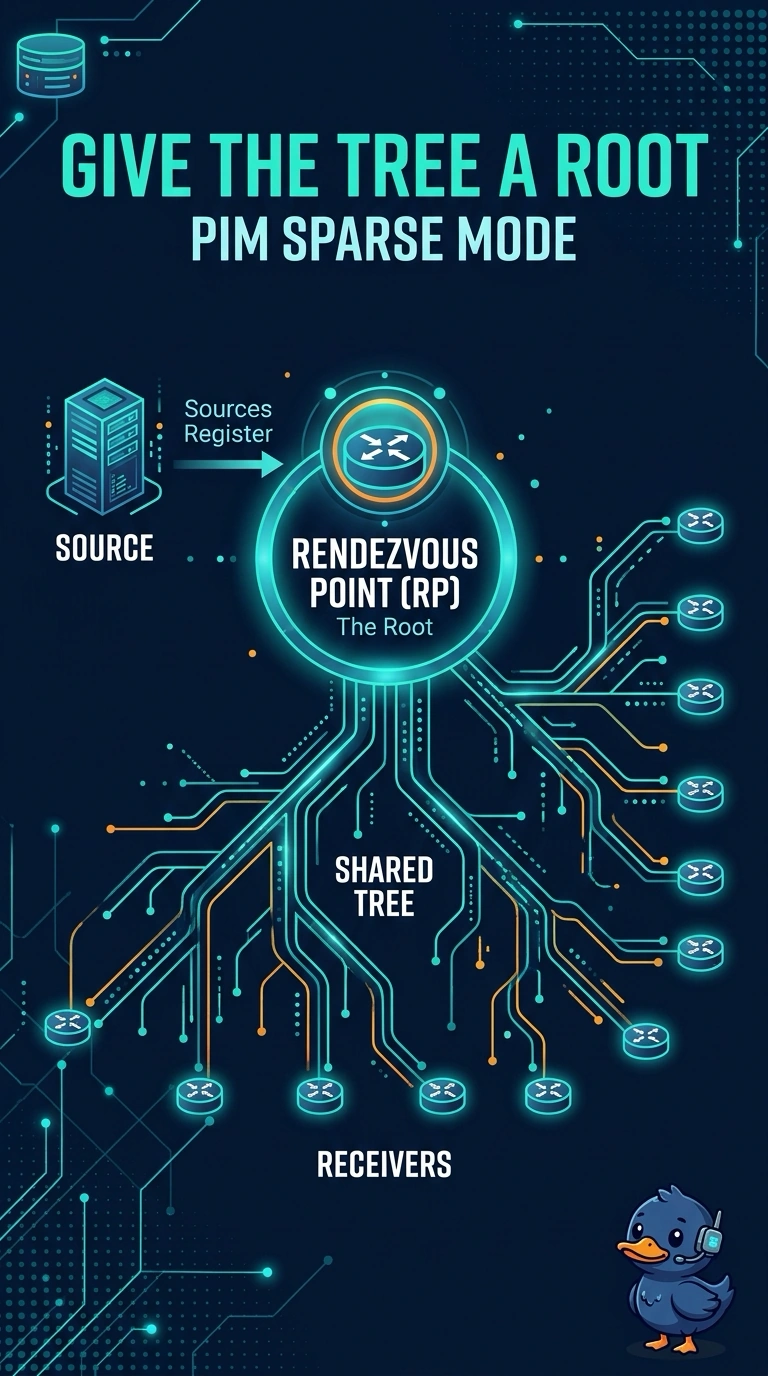
Sparse-mode multicast needs a meeting point, or the invitations have nowhere to go. You define a rendezvous point for the group so sources can register and receivers have a shared tree. HSRP can elect a gateway on the receiver VLAN and still leave this group with no rendezvous point.
Full Explanation
PIM sparse mode builds a shared tree rooted at a rendezvous point. Last-hop routers send joins toward that rendezvous point, and the first-hop router registers the source there. With no rendezvous point defined for the studio group, registration and the shared tree have no root, so receivers get nothing even though the source is sending. An HSRP virtual address on the receiver VLAN elects a gateway. It is not a multicast root and it does not give this group a rendezvous point. vPC peer-gateway lets a peer route packets sent to the other peer's gateway MAC. It does not elect a rendezvous point. An anycast gateway MAC is the VXLAN distributed-gateway address. It is unrelated to PIM sparse-mode tree building. Caveat: the rendezvous-point address has to be reachable in unicast, or defining it without a route leaves registration unable to complete. Operational check: configure the rendezvous point for the group, confirm the source registers, and confirm the receiver interface shows the group forwarding.