
A media company imported a logical configuration backup into a rebuilt UCS domain. Service profiles and pools returned, and the local usernames did not. Why are the local users missing?
Select an answer to reveal the explanation.
Short Explanation
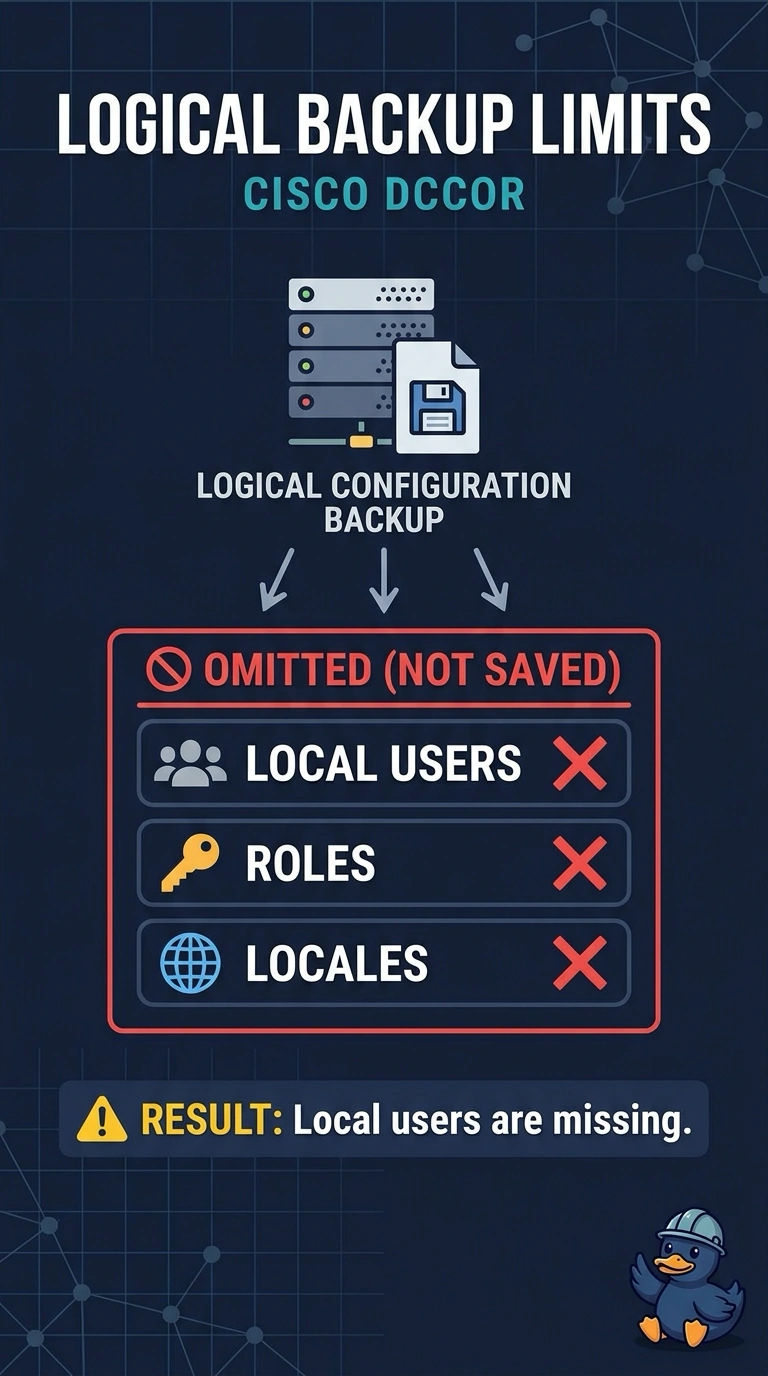
A logical backup is the packing list for the furniture, not the stack of staff badges. You got the service profiles, pools, and policies back, and the local usernames were never on that list. Those accounts live with the system configuration, so this import had nothing to restore.
Full Explanation
UCS logical configuration is an XML export of the service objects: profiles, templates, pools, policies, and the VLANs and VSANs that go with them. It does not include local users, roles, or locales. Those belong to the system configuration. Importing only the logical file therefore rebuilds the media company's profiles and leaves the local usernames absent. A logical backup is not a binary image. The binary snapshot is the full-state backup. Calling the logical file a binary that skips XML reverses both the format and the reason the users are missing. The host firmware package selects server firmware. It does not store UCS Manager user accounts, and a blade reboot will not recreate them. Acknowledging a chassis finishes hardware discovery. It does not rebuild AAA users from the IOM. Caveat: an all-configuration XML includes system and logical objects, and a full-state backup is the binary snapshot used to restore a system, so either of those is the place to look when users must return too. Operational check: confirm the imported file type is logical, then restore users from a system or all-configuration export, or recreate them, and test a local login.