
A media company is installing a UCS X-series chassis and wants server profiles and policies managed in Intersight, not in a local UCS Manager domain. Which management model matches that goal?
Select an answer to reveal the explanation.
Short Explanation
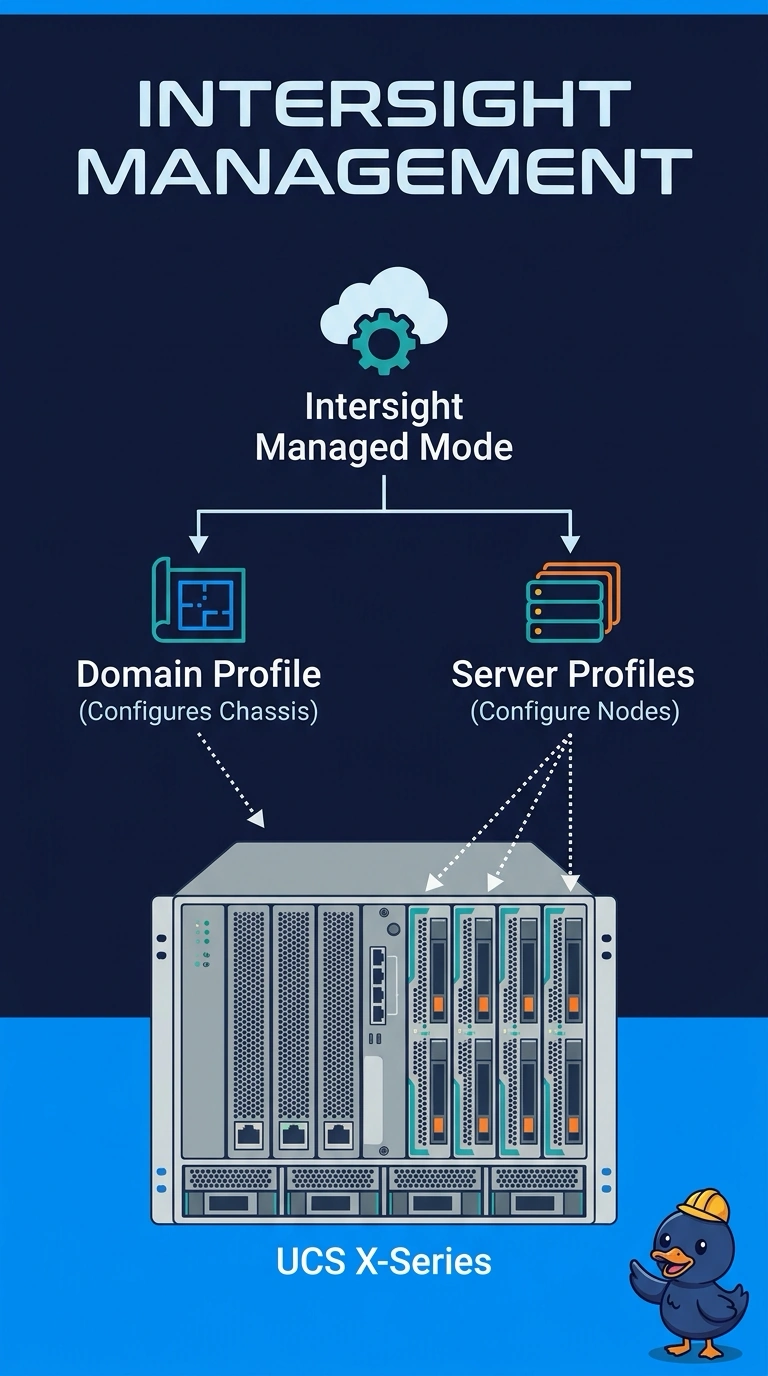
Think of Intersight Managed Mode as the front office for the whole chassis. You deploy a domain profile on the fabric interconnects and server profiles on the nodes so the policies stay in Intersight. Ethernet end-host mode only changes how frames leave toward the LAN, and it does not become that management plane.
Full Explanation
Intersight Managed Mode is the management model that keeps this X-series chassis in Intersight. The fabric interconnects are claimed there, a domain profile carries the domain-wide policies, and each compute node receives a server profile. That is how the media company gets server profiles and policies in Intersight. Ethernet end-host mode is only a forwarding mode toward the upstream LAN. Treating it as the cloud management plane for the X-series nodes does not create a domain profile or server profiles. Standalone CIMC sessions opened on each compute node configure that node locally. They do not give the chassis a shared domain profile or a server profile owned in Intersight. NPV mode on the fabric interconnects is a Fibre Channel edge behavior so a switch does not take a domain ID. It does not remove the need for server profiles, and it does not manage UCS X policies. Caveat: the domain profile has to be deployed before a server profile can use its VLANs and port roles, or Intersight Managed Mode is selected and the node profile still fails to apply. Operational check: confirm the interconnects report Intersight Managed Mode, the domain profile is deployed, and one X-series node shows a server profile associated from Intersight.