
A government agency's GPU cluster drops frames on a best-effort VLAN whenever the links congest, and the RoCEv2 jobs retry. Which fabric behavior do those jobs require?
Select an answer to reveal the explanation.
Short Explanation
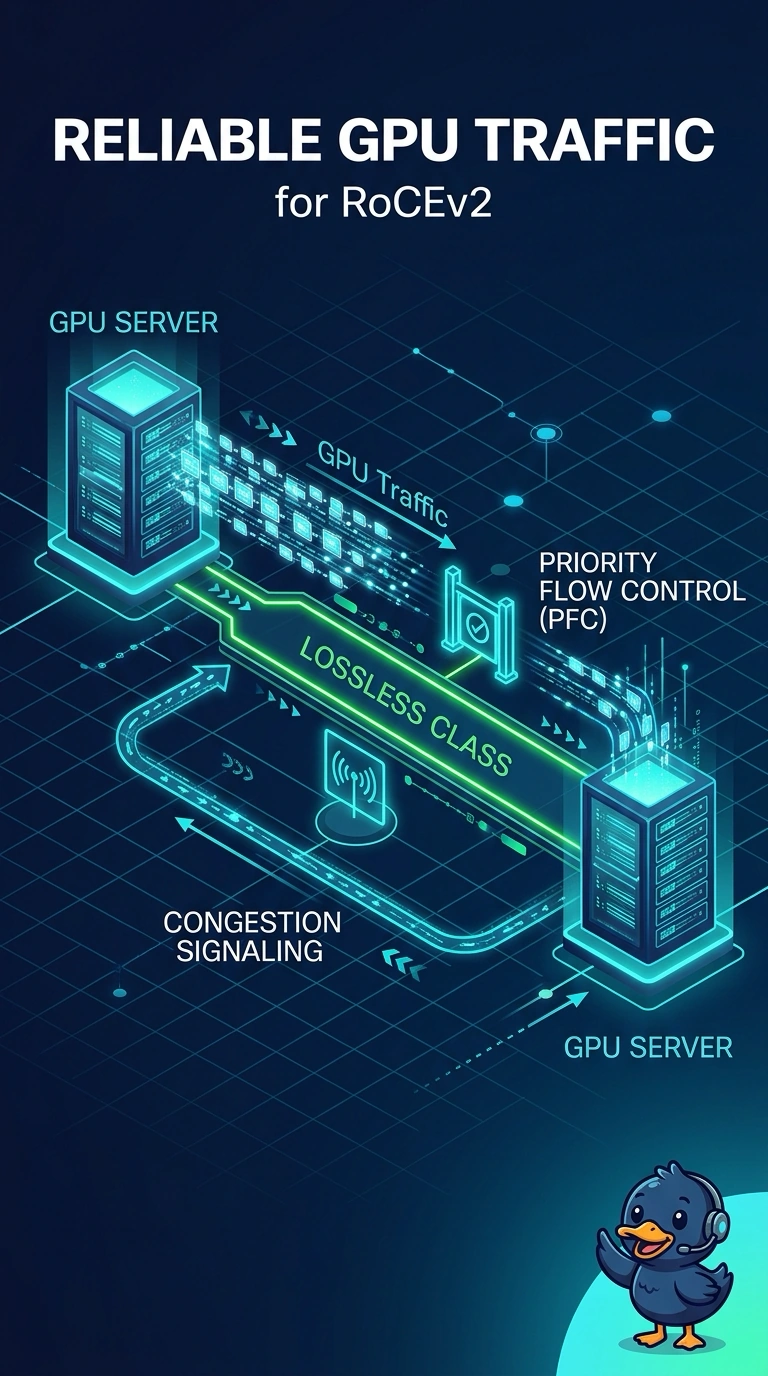
A convoy cannot afford to have random trucks vanish on the on-ramp. You give the GPU traffic a lossless class, with Priority Flow Control and congestion signaling, so the bursts RoCEv2 sends are paused and marked instead of thrown away. Encrypting the same best-effort VLAN does not stop the drops.
Full Explanation
RoCEv2 carries remote memory traffic over UDP, and a GPU job treats loss as a failure that must be retried. The fabric behavior that matches it is lossless Ethernet: Priority Flow Control pauses the lossless class instead of dropping it, and congestion signaling tells the senders to slow down before the buffers overflow. A best-effort VLAN does neither, which is why this agency sees drops and retries. Spanning tree builds a loop-free Layer 2 topology. It does not reassemble dropped frames, and a larger domain would not make a lossy class safe for RoCEv2. NPV is a Fibre Channel edge mode that avoids a domain ID on a SAN switch. It is not an Ethernet feature you enable to protect GPU traffic, and these servers are not asking for a Fibre Channel domain. MACsec encrypts frames hop by hop. It does not add pause behavior or congestion signals, so the best-effort class still drops when the queue fills. Caveat: Priority Flow Control has to be configured for the same class on each hop of the path, or one lossy hop still discards the burst. Operational check: confirm the GPU class is paused end to end, confirm congestion signaling is on for that class, and rerun a job to see the retries drop when the links congest.