
A logistics company wants a troubleshooting script on a Nexus switch to use its own IP address and its own routing table, separate from the switch management VRF. Which environment provides that separate network namespace?
Select an answer to reveal the explanation.
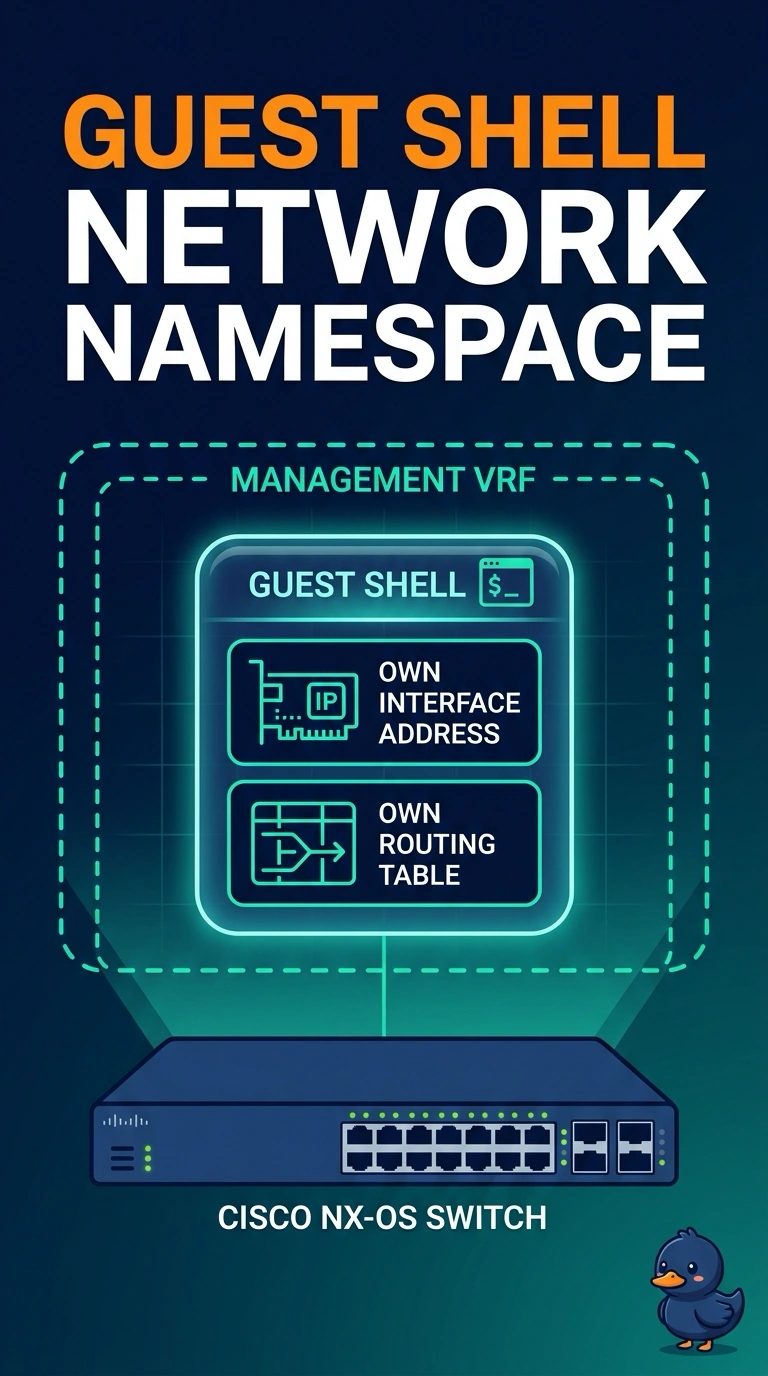
Short Explanation
Think of the guest shell as a small office with its own front door, not a desk in the main lobby. You give that office an address and routes of its own so the script does not borrow the switch management VRF. Native bash still lives in the switch environment and does not hand you that separate namespace.
Full Explanation
Guest shell is a Linux environment on NX-OS with its own network namespace. You can give it an address and routes that are independent of the switch management VRF, which is what this logistics script needs when it must be reached, or must reach a collector, on its own. Native bash runs in the switch environment. Enabling it does not create a second management VRF or a private routing table for scripts. POAP is a day-0 process that looks for a script when the switch has no startup configuration. It is not a standing namespace you use for a troubleshooting tool after the switch is in service. An EEM applet matches an event and runs an action such as a CLI command. The action does not open a private routing table, and the applet is not a Linux network namespace. Caveat: the guest shell still needs its feature enabled and a path into the network you want it to use, or the private table has nowhere to forward. Operational check: from inside the guest shell, confirm its address and default route are the ones you assigned, and confirm those are not the same entries as the switch management VRF.