
A government agency Nexus boots with no startup configuration and begins POAP, requesting an address from DHCP. The engineer wants the normal CLI and does not want a scripted install. What is the right conclusion?
Select an answer to reveal the explanation.
Short Explanation
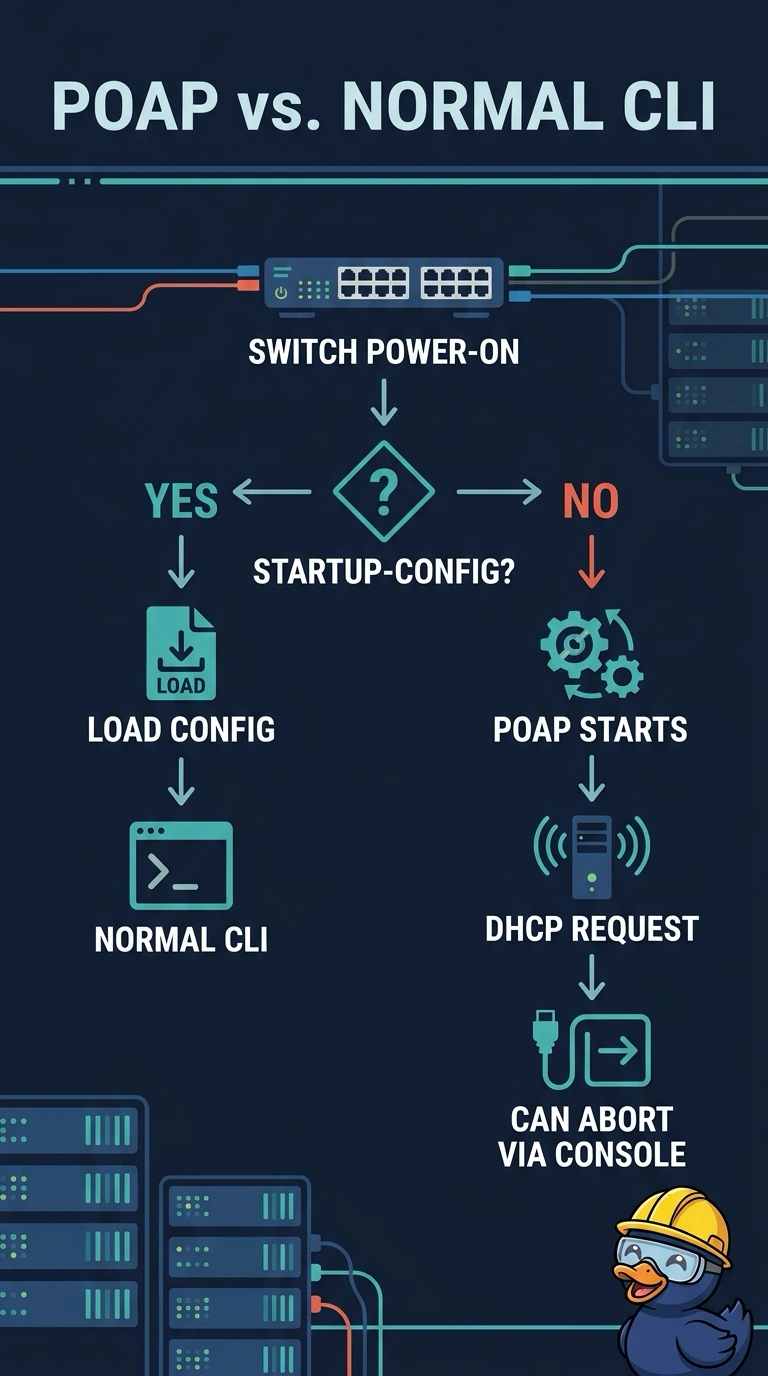
POAP is the unboxing script, and it runs because the box is empty. You see it start when startup configuration is missing, and you can abort it when you want the normal CLI instead. It is not a nightly scheduler and it does not run just because the switch reloaded with a saved config.
Full Explanation
PowerOn Auto Provisioning runs when a Nexus boots without a startup configuration. It uses DHCP to find an image and a script so a new switch can be installed without a manual setup. The agency switch is in that state, which is why POAP started. From the console the engineer can abort POAP and continue with the normal CLI instead of waiting for a scripted install. POAP does not run on a reload that already has a startup configuration. It is not the onboard scheduler, and aborting it does not delete scheduler jobs. It also has nothing to do with CFS or the device-alias database, so aborting it does not isolate a Fibre Channel fabric. Caveat: aborting POAP leaves the switch without the scripted configuration, so the engineer has to apply an image and a configuration some other way before the switch is useful in production. Operational check: on a lab boot with an empty startup configuration, confirm POAP begins, abort it, and confirm the console returns to the normal CLI. DHCP only points at the script. Aborting POAP does not delete a startup configuration that was never saved.