
A government agency created a scheduler job that records interface status, but the job has never run. The job exists, and no timetable is associated with it. What has to be added?
Select an answer to reveal the explanation.
Short Explanation
A job with no calendar is a note left on a desk. You still need a scheduler timetable that runs this interface-status job at the time you picked. An EEM syslog trigger would wait for a message this task does not require.
Full Explanation
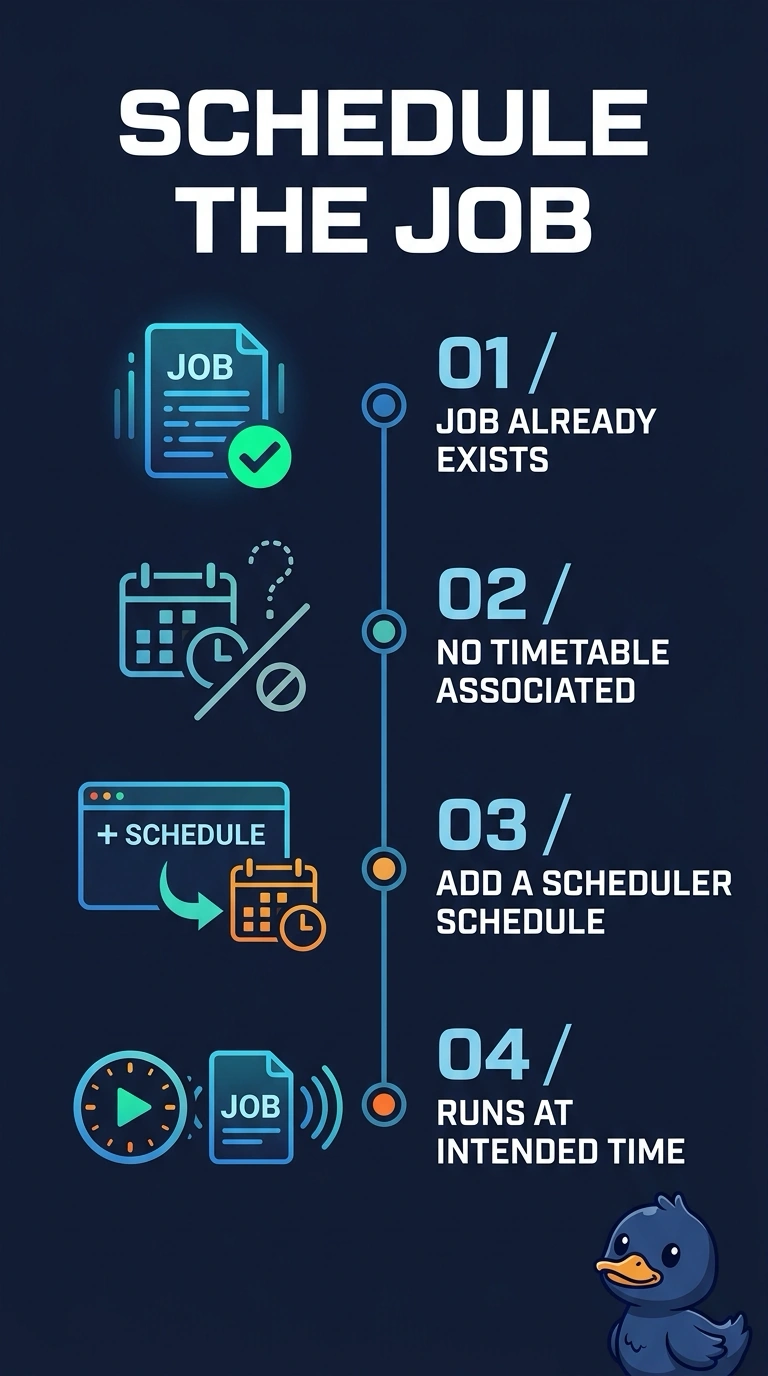
The NX-OS scheduler separates the job, which holds the command, from the schedule, which says when that job runs. A defined job with no timetable sits idle, so the agency never gets the interface-status record even though the command inside the job is valid. Adding a schedule and attaching the job to it is what makes the clock call the command. An EEM syslog pattern runs only when a matching message is logged. This task is supposed to run at a chosen time whether or not anything fails, so a syslog detector would skip quiet periods and is the wrong facility. POAP runs when a switch boots without a startup configuration and looks for an initial image and script. It is not the engine behind a recurring scheduler job, and a saved configuration does not block the scheduler. A SPAN session copies frames. It does not execute a show command or store interface status because a schedule fired. Caveat: the scheduler feature has to be enabled and the switch clock has to be trustworthy, or the timetable hits a time the operator did not mean. Operational check: show the schedule binding, wait through one test window, and confirm a new status record appears even when the logging buffer stayed quiet.