
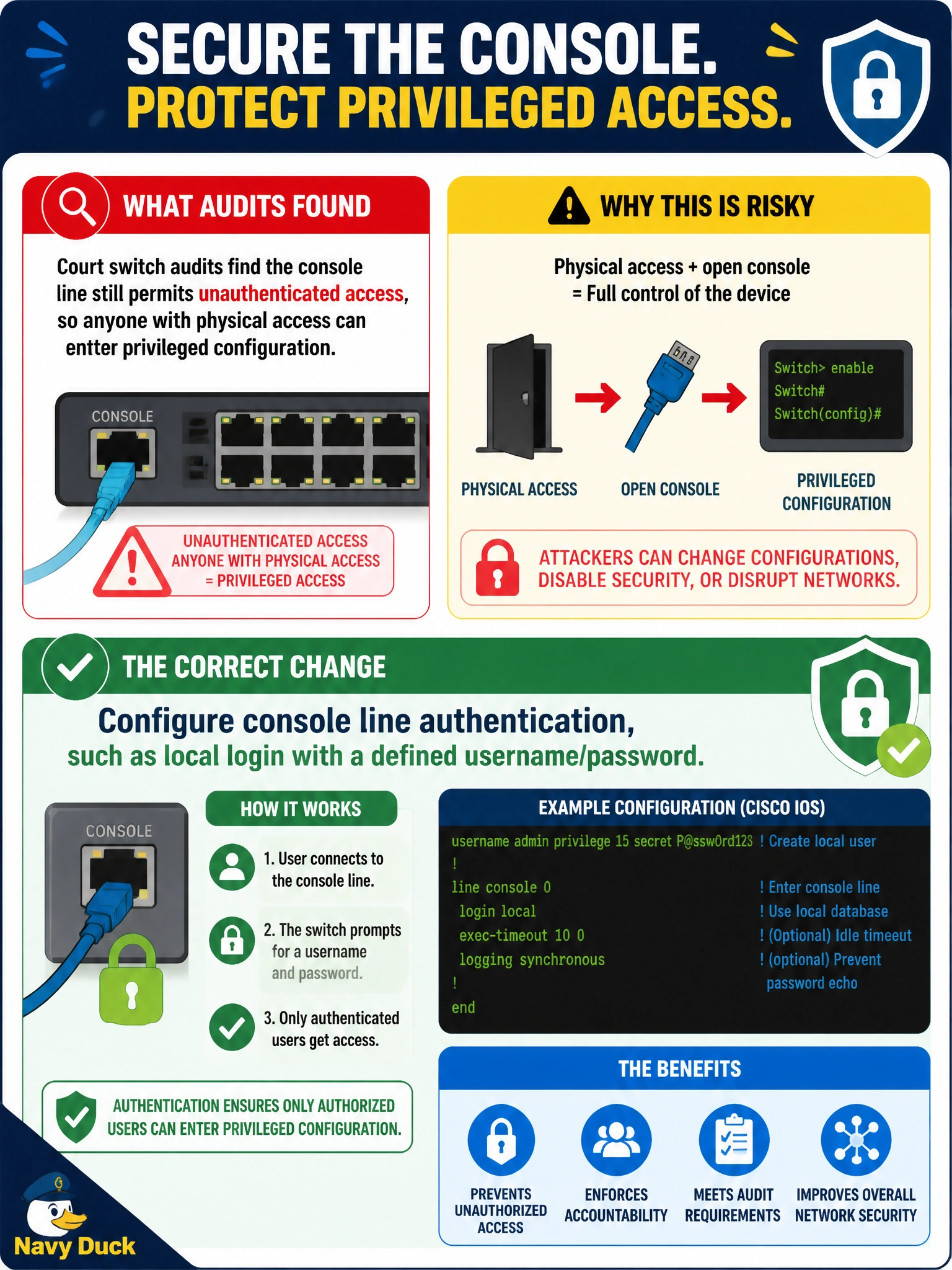
Court switch audits find the console line still permits unauthenticated access, so anyone with physical access can enter privileged configuration. What change correctly addresses that finding?
Select an answer to reveal the explanation.
Short Explanation
A physical console should not be an all-access pass. Configure local login on the console line with a defined username and password, so you require credentials even when someone is beside the switch.
Full Explanation
Court switch audits find the console line still permits unauthenticated access, allowing anyone with physical access to enter privileged configuration. Configure console line authentication, such as local login with a defined username and password, together with the related line and login configuration. This requires credentials instead of dropping directly into an unauthenticated EXEC session that can escalate to configuration. Disabling all logging so console users cannot be traced does not authenticate the console and worsens forensics. Moving the console cable to an access VLAN trunk and enabling DTP concerns unrelated Layer 2 port behavior; it does not authenticate serial console users. Applying CoPP because it supposedly verifies users is also incorrect: CoPP rate-limits or protects the control plane but is not a console authentication mechanism. Exam caveat: console hardening is distinct from VTY/SSH hardening; physical access still needs line authentication and privileged password protections. Practical check: apply console login authentication with known local credentials, verify unauthenticated console access is denied, confirm authorized staff can still recover devices, and retain logging or AAA accounting where policy requires an audit trail of privileged access.