
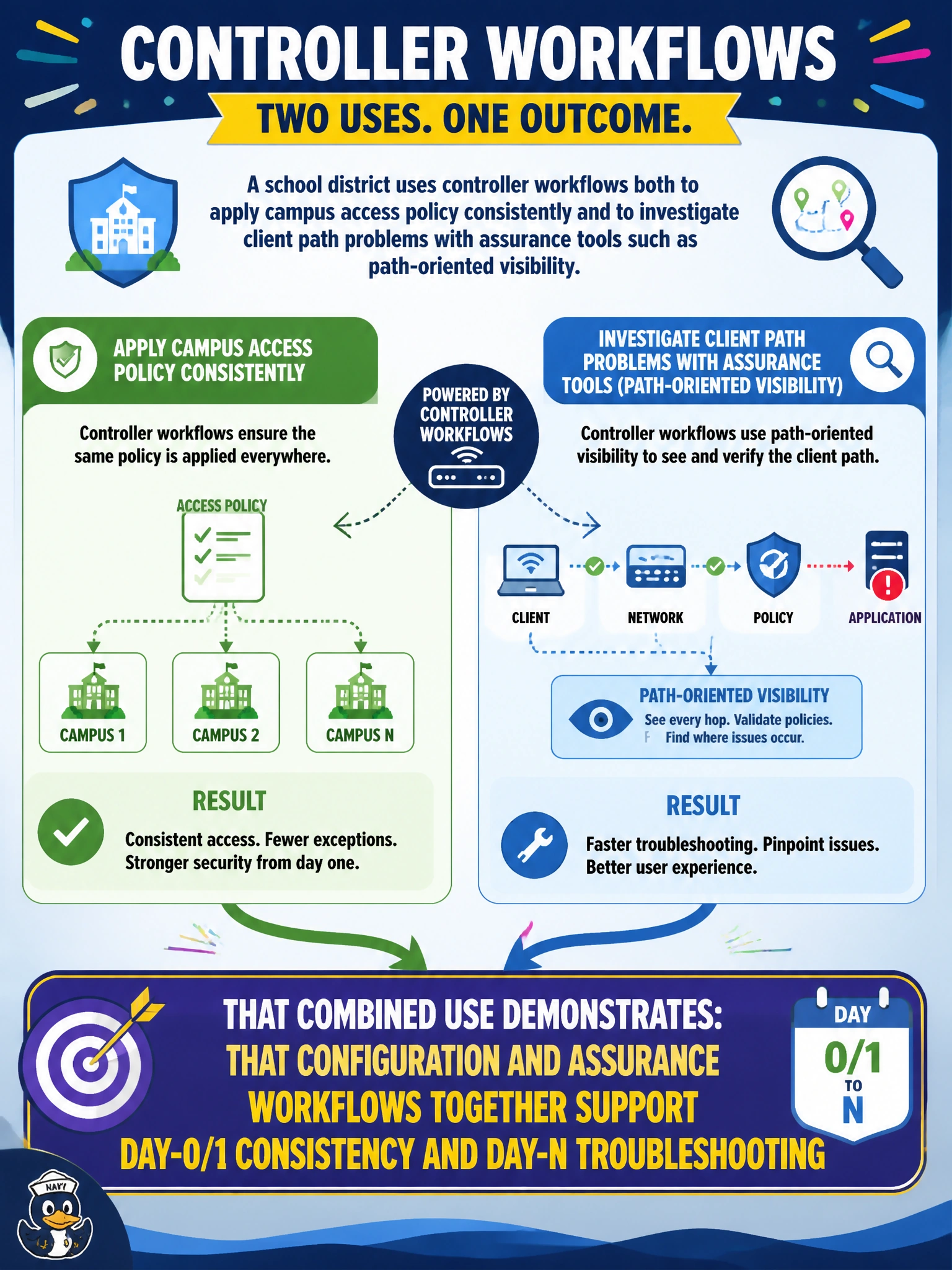
A school district uses controller workflows both to apply campus access policy consistently and to investigate client path problems with assurance tools such as path-oriented visibility. What does that combined use demonstrate?
Select an answer to reveal the explanation.
Short Explanation
Push the standard build, then use assurance when a student’s laptop takes a weird path—that is controller life: configuration plus monitoring, not one or the other.
Full Explanation
A school district uses controller workflows both to apply campus access policy consistently and to investigate client path problems with assurance tools such as path-oriented visibility. That combined use demonstrates that configuration and assurance workflows together support day-0/1 consistency and day-N troubleshooting: templates/policy pushes keep access policy uniform at deployment time, while assurance and path visibility help explain user problems after the network is live.
Claiming DNA Center can only monitor and never push configuration fails by concept—configuration/provisioning workflows are a core family alongside assurance. Saying assurance tools replace the need for any device inventory is wrong; inventory underpins management and often feeds assurance context. Claiming path visibility requires disabling all AAA on wireless is unrelated and unsafe; AAA remains part of secure onboarding while assurance investigates paths.
Exam caveat: do not treat configuration and assurance as mutually exclusive—ENCOR expects recognition that controllers cover both consistent deployment and ongoing health/path insight.
Operational check for the school district: deploy a standard access policy via controller configuration workflows, then use assurance/path visibility when a classroom client fails, confirming policy intent and actual path/health align before making one-off CLI exceptions that recreate drift.