
A city wants Cisco DNA Center (Catalyst Center family) to push consistent access-switch port templates to closet devices instead of hand-editing each switch. Which workflow family addresses that goal?
Select an answer to reveal the explanation.
Short Explanation
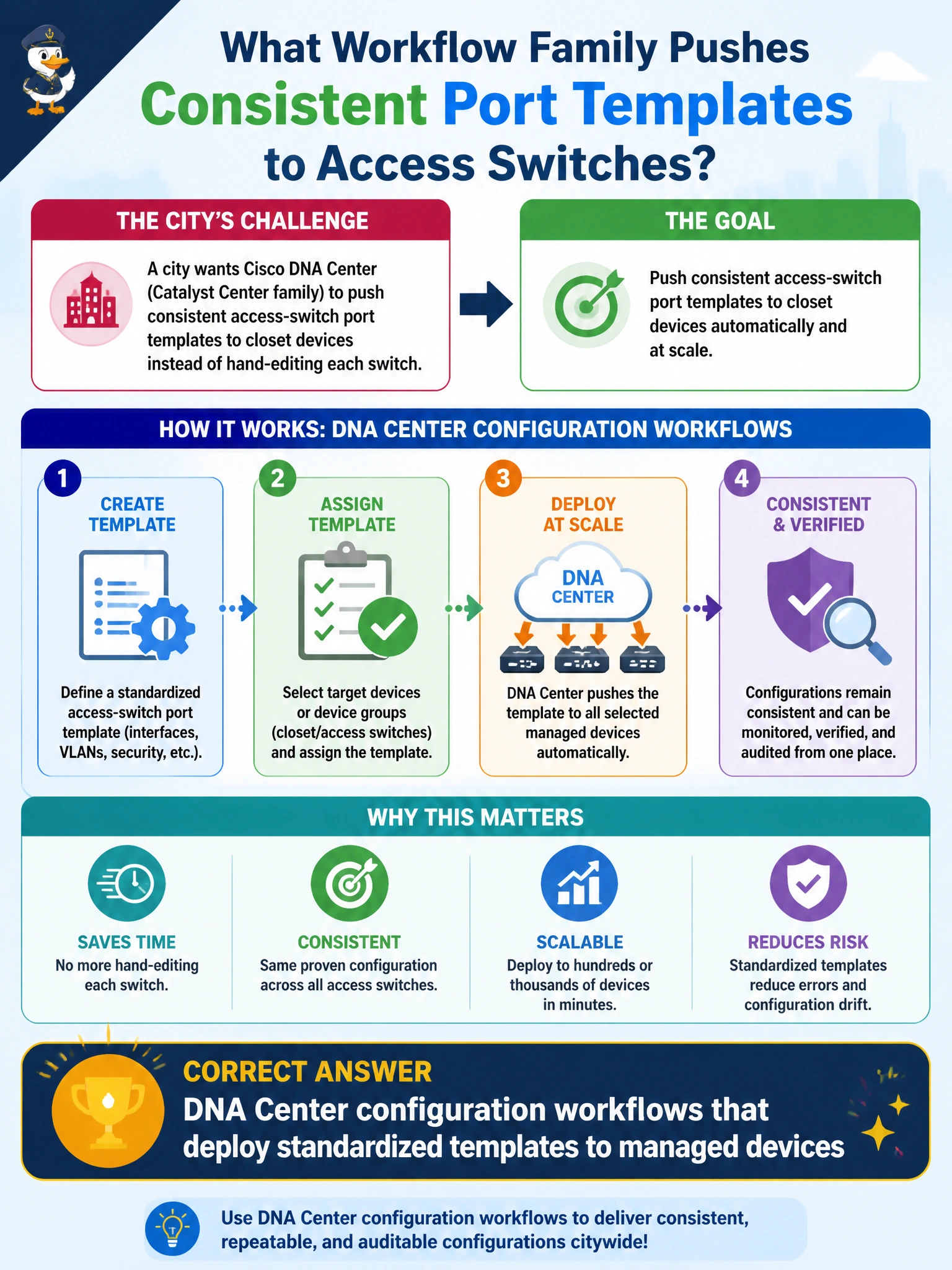
DNA Center configuration workflows are the city’s cookie-cutter for closet switches—one template pattern, many devices, far less one-off CLI art.
Full Explanation
The city wants Cisco DNA Center (Catalyst Center family) to push consistent access-switch port templates to closet devices instead of hand-editing each switch. That goal is addressed by DNA Center configuration workflows that deploy standardized templates to managed devices: the controller holds inventory, applies consistent port/access policy templates, and reduces drift from per-switch manual edits across many closets.
ERSPAN design worksheets stored only in Excel fail by concept—they are documentation, not a controller configuration workflow that pushes templates. Manual TFTP of unique running-configs with no controller inventory perpetuates one-off configs and misses the consistency/automation intent. Disabling NETCONF on all edges so templates apply via Telnet macros moves away from modern model-driven/controller operations and is not the DNA Center template workflow family described in ENCOR assurance/management topics.
Exam caveat: DNA Center/Catalyst Center workflow families include configuration (templates/provisioning), monitoring/assurance, and management (inventory/images). Map the stem’s verbs—“push templates,” “client health,” “inventory/images”—to the correct family.
Operational check for the city closets: onboard switches into DNA Center inventory, assign and deploy the access port template, verify interfaces match the standard, and sample a closet after change windows to confirm drift has not returned via local CLI edits.