
Courts networking wants customizable 5-tuple visibility rather than a legacy fixed NetFlow record format. What distinguishes Flexible NetFlow for that goal?
Select an answer to reveal the explanation.
Short Explanation
Old fixed NetFlow is a set lunch menu. Flexible NetFlow is build-your-own: pick the 5-tuple keys the courts actually care about. Same kitchen, way more control over what gets counted.
Full Explanation
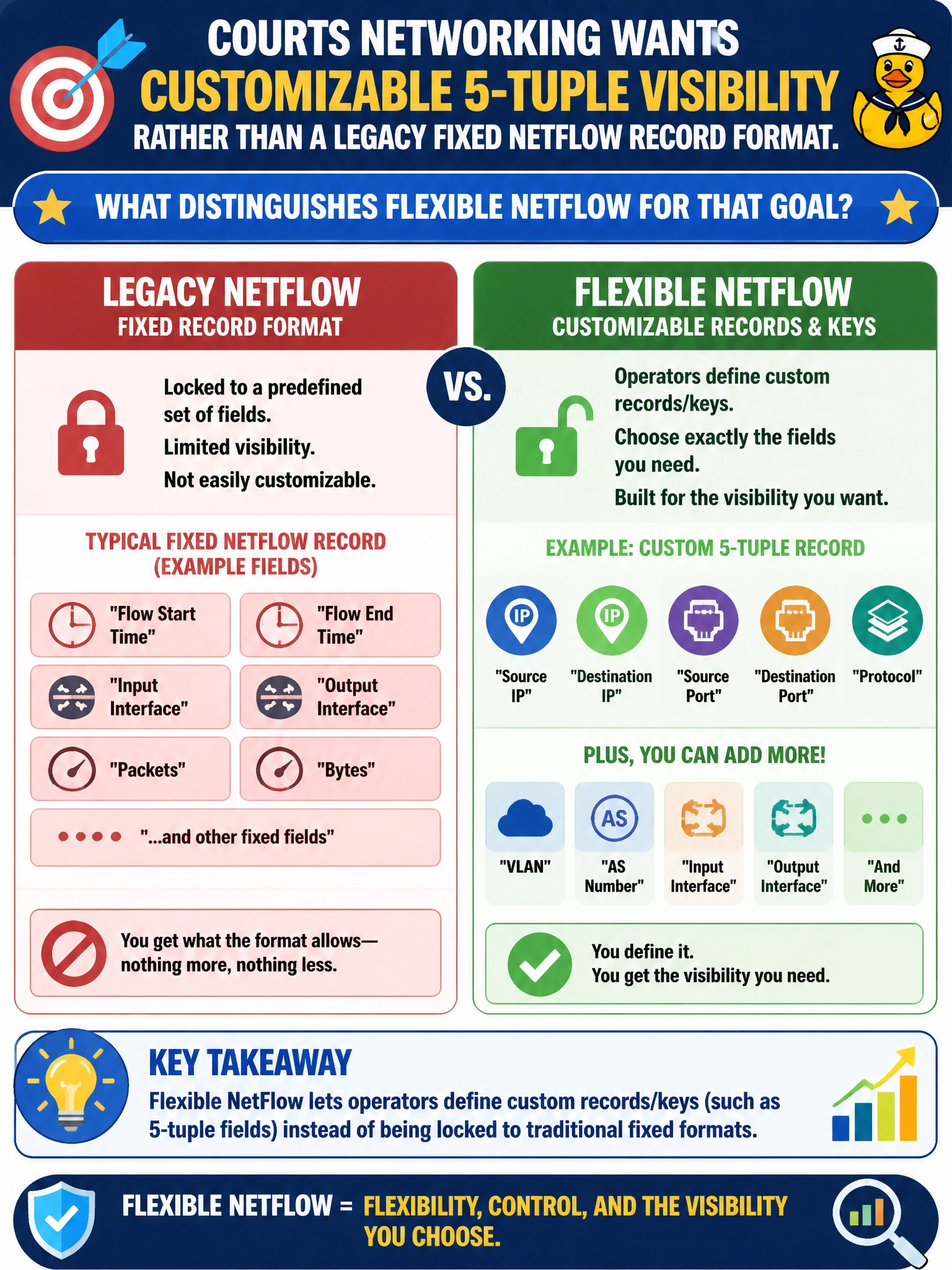
Courts networking that wants customizable 5-tuple visibility rather than a legacy fixed NetFlow record format should recognize what distinguishes Flexible NetFlow. Flexible NetFlow lets operators define custom records and keys—such as 5-tuple fields—instead of being locked to traditional fixed formats. That customization lets a municipal courts team export exactly the match/collect fields needed for evidence-adjacent traffic review, QoS validation, or segmentation checks without accepting a one-size-fits-all legacy record.
Claiming Flexible NetFlow can only export interface descriptions, never IP addresses or ports, fails because custom records commonly include addresses and L4 ports when configured. Claiming it replaces syslog and cannot coexist with SNMP polling fails because NetFlow complements other assurance tools rather than retiring them. Claiming it requires disabling CEF before any flow cache can form fails because modern NetFlow/Flexible NetFlow operation is designed to work with CEF-based forwarding, not to require CEF to be disabled.
Exam caveat: “flexible” means user-defined records/keys versus fixed classical formats—that is the distinction to memorize. Export still depends on a reachable collector and consistent templates; flexibility does not remove operational verification.
Operational check: define a record matching the desired 5-tuple, attach monitor/exporter on the courts interfaces of interest, verify template and flow arrival on the collector, and sample a known session to confirm the custom keys populate as expected.