
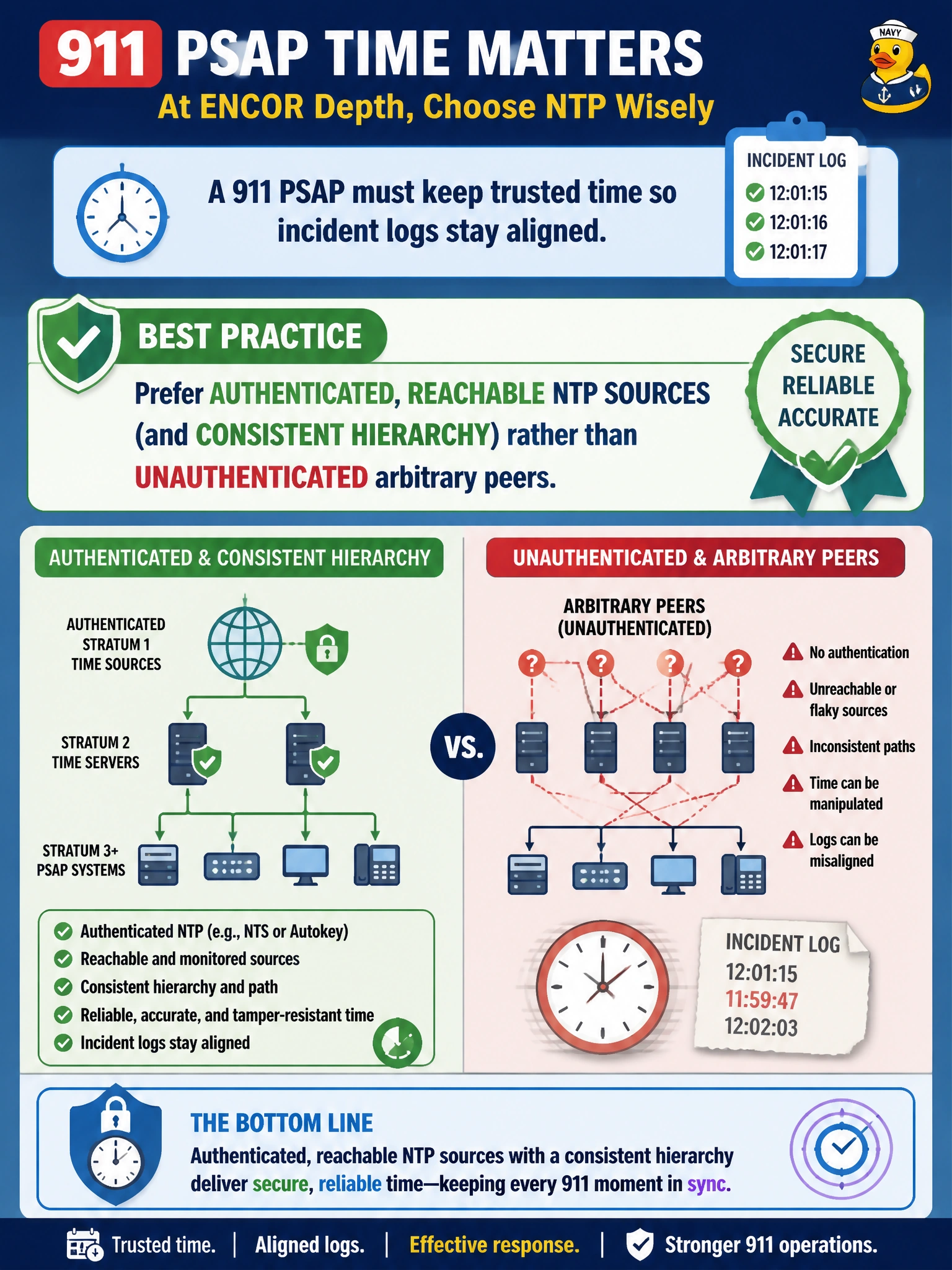
A 911 PSAP must keep trusted time so incident logs stay aligned. When interpreting NTP choices at ENCOR depth, which practice best supports a secure, reliable time source?
Select an answer to reveal the explanation.
Short Explanation
Dispatch logs are only as good as the wall clock behind them. Pick NTP servers you trust, lock them down with authentication when you can, and keep a clean hierarchy—don’t let every random peer on the Internet become your time boss.
Full Explanation
A 911 PSAP must keep trusted time so incident logs stay aligned across recorders, CAD, and network devices. At ENCOR depth, the practice that best supports a secure, reliable time source is preferring authenticated, reachable NTP sources and a consistent hierarchy rather than unauthenticated arbitrary peers. Authenticated associations and a deliberate stratum design reduce the chance that a spoofed or random peer skews timestamps used in after-action reviews and evidence correlation. Municipal public-safety networks treat time as an integrity control, not an optional convenience.
Disabling all NTP and setting clocks manually once per fiscal year fails because manual clocks drift, reboot to wrong time, and destroy cross-device correlation after outages. Using IGMP snooping alone to distribute time as multicast IPTV channels fails because IGMP snooping constrains multicast receiver ports; it is not an authoritative time distribution architecture. Relying on HSRP preempt timers as the authoritative clock stratum fails because HSRP preempt is failover timing for gateways, not a time-of-day stratum source for log hosts.
Exam caveat: associate NTP with trusted sources, authentication where supported, and hierarchy—not with FHRP timers or IGMP. Questions may tempt you with “any peer is fine” or “manual is simpler”; for PSAP-grade logging, trusted NTP is the defendable answer. Stratum indicates distance from the reference clock; it is not a substitute for authentication decisions.
Operational check: verify NTP associations (show ntp associations / status), confirm authentication keys where configured, check offset and stratum stability on PSAP appliances, and correlate a test event’s timestamps across syslog and application logs.