
A stadium ABR summarizes campus prefixes toward other OSPF areas. After a link failure inside the summarized range, remote routers no longer see more-specific prefixes. What trade-off should engineers expect?
Select an answer to reveal the explanation.
Short Explanation
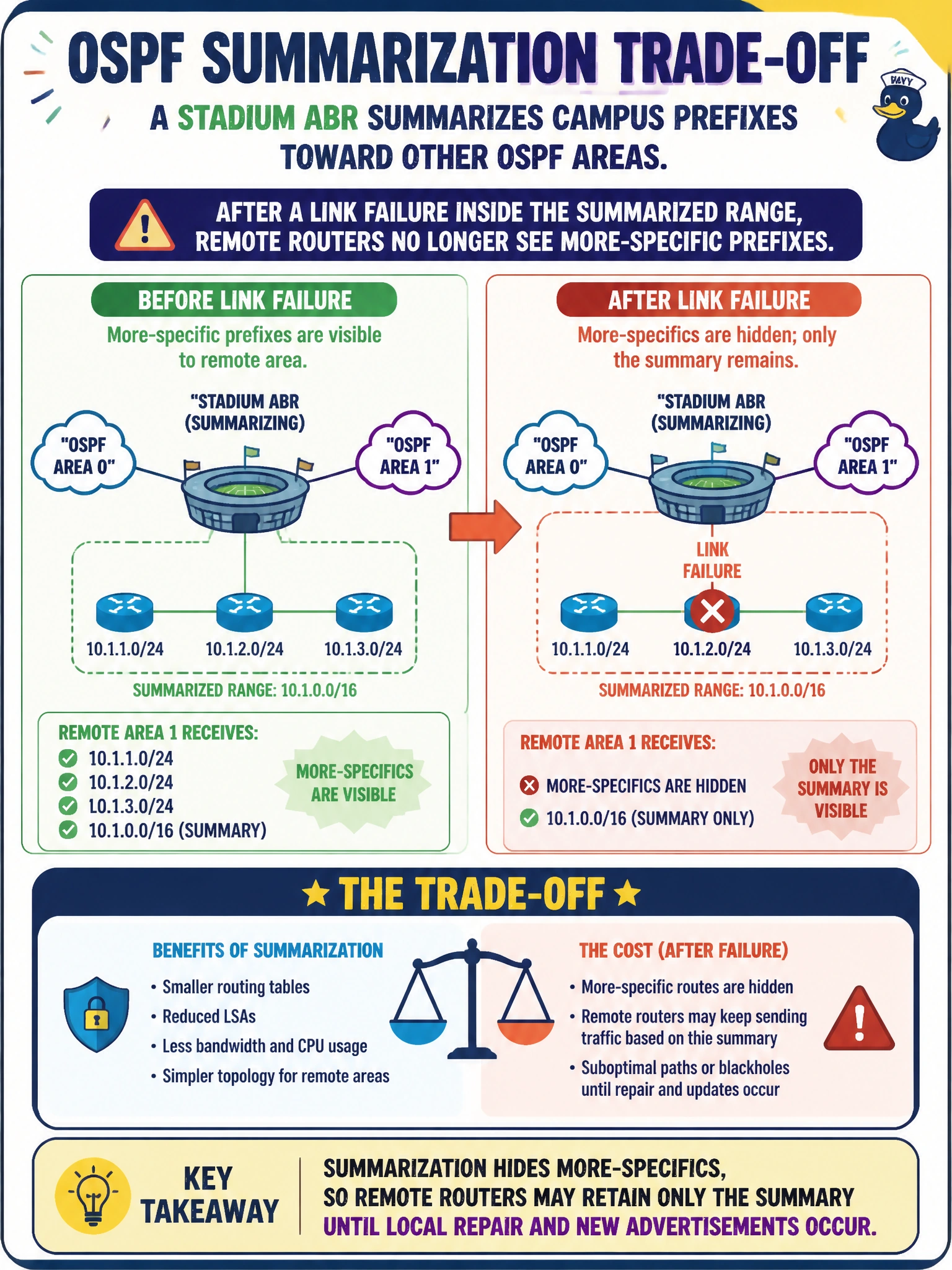
A summary is like a stadium section sign — when one seat breaks, folks outside still only see "Section 100," not the broken chair. Hiding more-specifics is the trade-off: smaller tables, less granular remote visibility after failures. It doesn't spawn host LSAs or kill HSRP.
Full Explanation
When a stadium ABR summarizes campus prefixes toward other OSPF areas and a link fails inside the summarized range, remote routers may no longer see more-specific prefixes—that is the expected trade-off. Summarization hides component more-specifics behind an aggregate Type-3; remote areas retain the summary and forward toward the ABR until local repair occurs and advertisements change. Visibility into every failed leaf prefix is intentionally reduced for scale, so remote SPF sees less churn but also less detail.
Claiming summarization always creates extra Type-1 LSAs for every host NIC reverses the goal: summarization reduces inter-area detail rather than multiplying host Type-1s remotely. Expecting remote areas to gain more-specific host routes automatically after every failure contradicts summary hiding; more-specifics stay local unless advertised. Saying OSPF summarization disables all first-hop redundancy protocols citywide is unrelated—HSRP/VRRP operation is not turned off by area ranges.
Exam caveat: if the ABR advertises a summary without a viable component route, traffic for the aggregate can black-hole until the summary is withdrawn—discard routes/null0 for the summary are common hygiene. Summarization points belong on ABRs for inter-area Type-3 control. ENCOR wants the scale-versus-visibility trade-off, not FHRP side myths.
Operational check: before and after a lab failure inside the stadium summary, compare OSPF databases on a remote civic router—more-specifics should be absent while the summary remains until the ABR reacts. Confirm local stadium routers still see detailed intra-area LSAs and repair. Validate null0/discard for the summary on the ABR so orphaned aggregate traffic does not loop.