
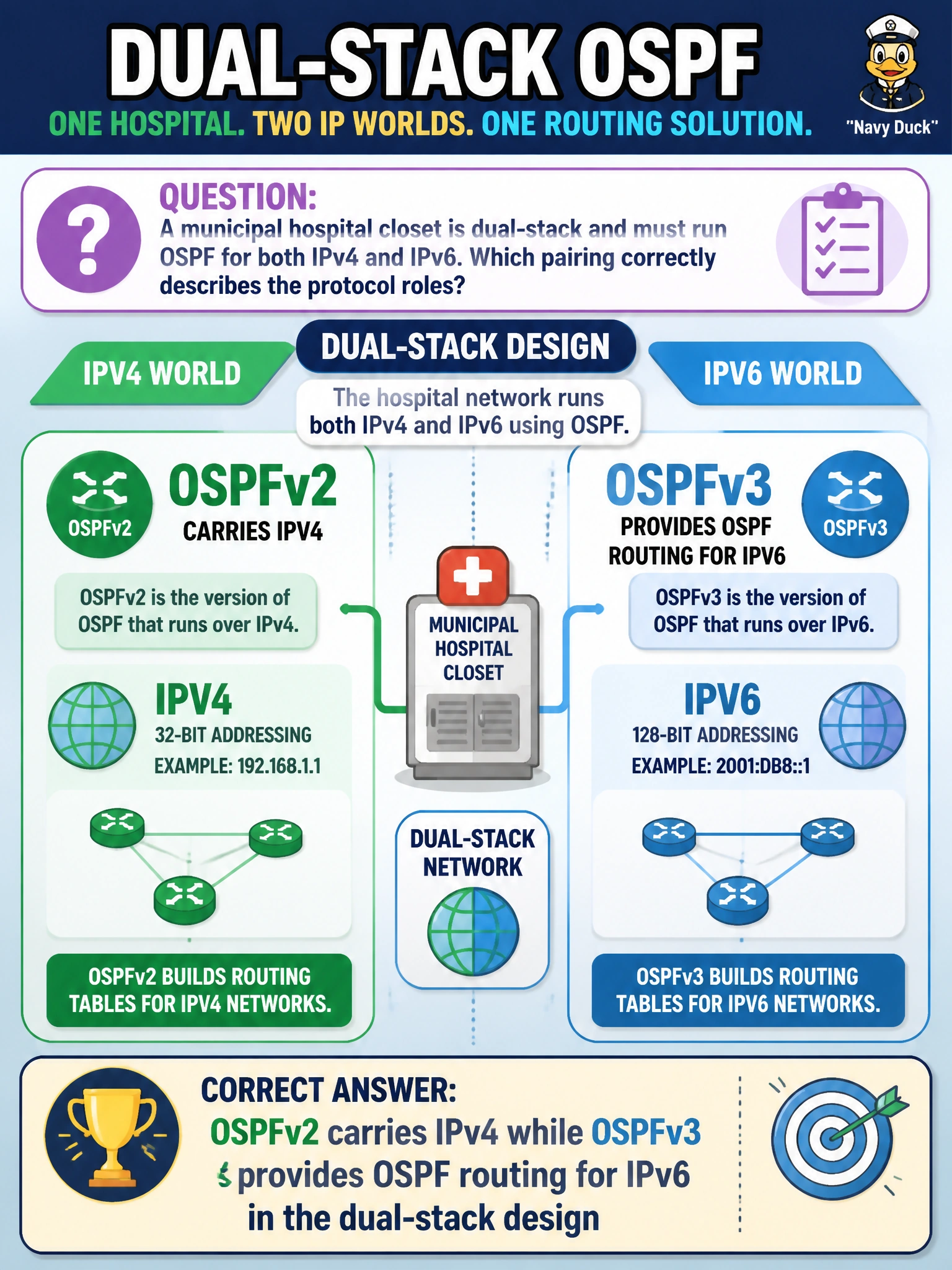
A municipal hospital closet is dual-stack and must run OSPF for both IPv4 and IPv6. Which pairing correctly describes the protocol roles?
Select an answer to reveal the explanation.
Short Explanation
In your dual-stack closet, think of IPv4 and IPv6 as two lanes: OSPFv2 handles the IPv4 lane, and OSPFv3 handles the IPv6 lane. Keep those roles straight, and remember that HSRP doesn't forbid either OSPF version.
Full Explanation
In the municipal hospital’s dual-stack closet, OSPFv2 carries IPv4 routes, while OSPFv3 provides OSPF routing for IPv6. OSPFv2 remains the classic version for IPv4 prefixes; OSPFv3 provides OSPF for IPv6. Modern address-family deployments can also structure OSPFv3 per address family, but the ENCOR dual-stack teaching point here is v2 for IPv4 and v3 for IPv6. Both versions can run concurrently on dual-stack interfaces, with each protocol family maintaining its OSPF adjacencies and link-state database as designed. The claim that OSPFv3 replaces spanning tree on IPv4 links and is not used to advertise IPv6 routes confuses Layer 2 loop prevention with Layer 3 routing and misstates OSPFv3’s IPv6 role. The claim that OSPFv2 is required for IPv6 and OSPFv3 is IPv4-only reverses the version roles. The claim that neither version can run with HSRP on an SVI is also false: first-hop redundancy and OSPF routinely coexist on SVIs in campus designs. Exam caveat: dual-stack means both protocol stacks are active; it does not mean OSPFv3 replaces OSPFv2 for everything unless the design explicitly uses an OSPFv3 address-family model for IPv4. HSRP does not prevent OSPF from running. Practical check: on the Layer 3 switch, verify OSPFv2 neighbors and IPv4 routes, OSPFv3 neighbors and IPv6 routes, and HSRP virtual-IP behavior on the dual-stack SVIs and uplinks. If only one family forms neighbors, check address-family enablement, interface OSPF configuration, and passive settings for that stack.