
A municipal stadium aggregates two 10-Gbps distribution uplinks from an access switch into one logical Port-Channel. What primary benefit does that EtherChannel pattern provide?
Select an answer to reveal the explanation.
Short Explanation
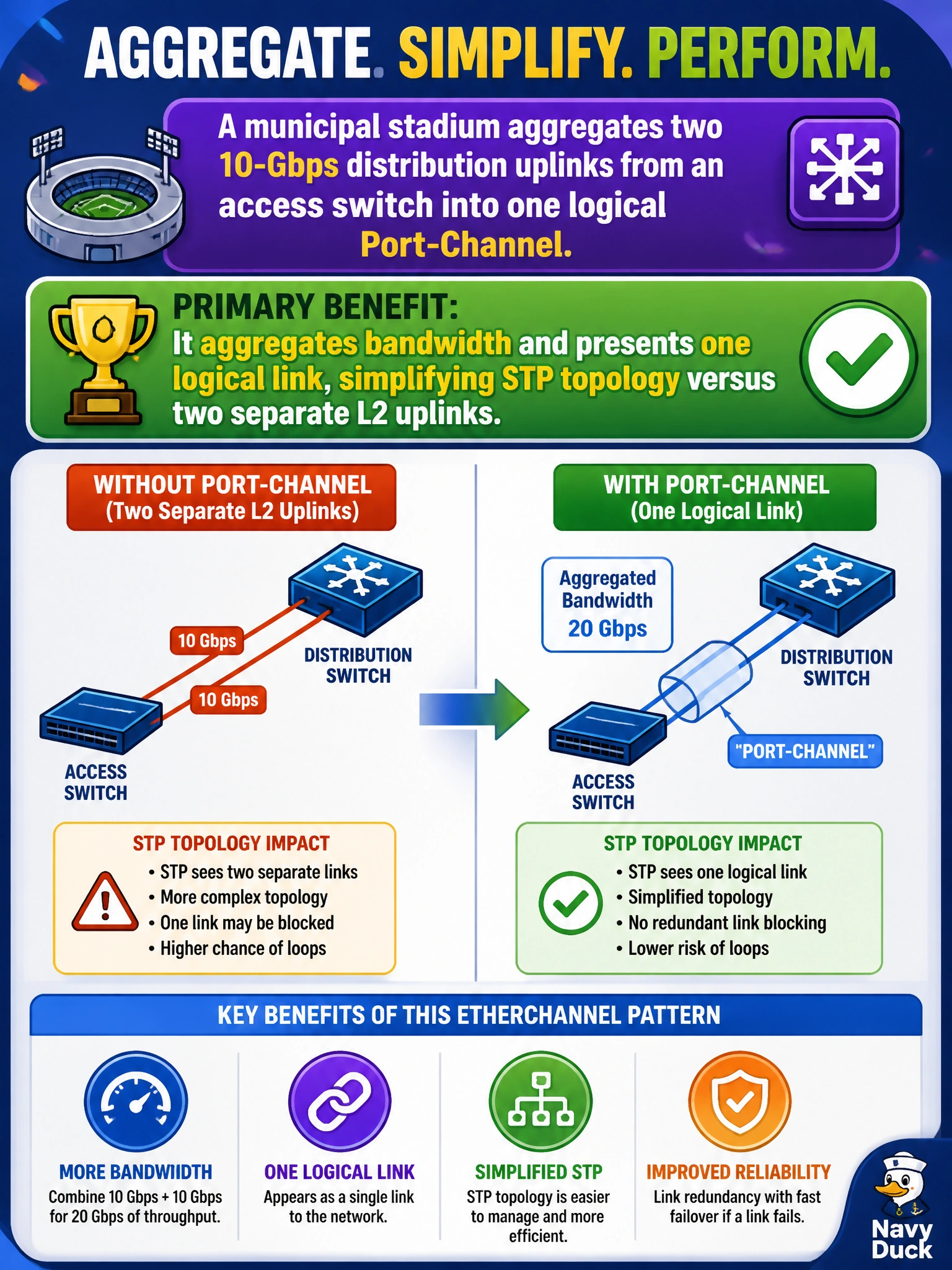
Two separate uplinks make STP pick a winner and bench the other. Bundle them into EtherChannel and the stadium gets one logical pipe with more horsepower and a cleaner spanning-tree picture.
Full Explanation
Bundling two 10-Gbps distribution uplinks from a municipal stadium access switch into one Port-Channel aggregates bandwidth and presents a single logical uplink to spanning tree. Instead of two independent L2 paths where STP forwards on one and blocks the other, the channel is one STP edge that can use both physical members for capacity (subject to hashing). That pattern simplifies the STP topology while increasing aggregate throughput—the primary benefit the stem targets.
Replacing spanning tree entirely so both links always forward as independent trunks is incorrect: without a channel, STP still blocks one independent path; EtherChannel does not mean “disable STP.” Converting the uplinks into Layer-3 GRE tunnels without routing configuration invents a tunnel transformation EtherChannel does not perform. Forcing native VLAN mismatch detection to disable both members permanently is unrelated scare behavior; native VLAN mismatch is a separate trunk problem and is not the purpose of EtherChannel.
Exam caveat: EtherChannel still requires matching member attributes and a compatible negotiation mode (LACP preferred). Single-flow hashing may not fill both 10G members with one session. If the Port-Channel is a trunk, keep native VLAN and allowed lists consistent on the logical interface.
Operational check: form the stadium Port-Channel with LACP, verify one logical uplink in spanning tree, confirm both members are active, measure aggregate capacity under multi-flow load, and document hash method for operations.