
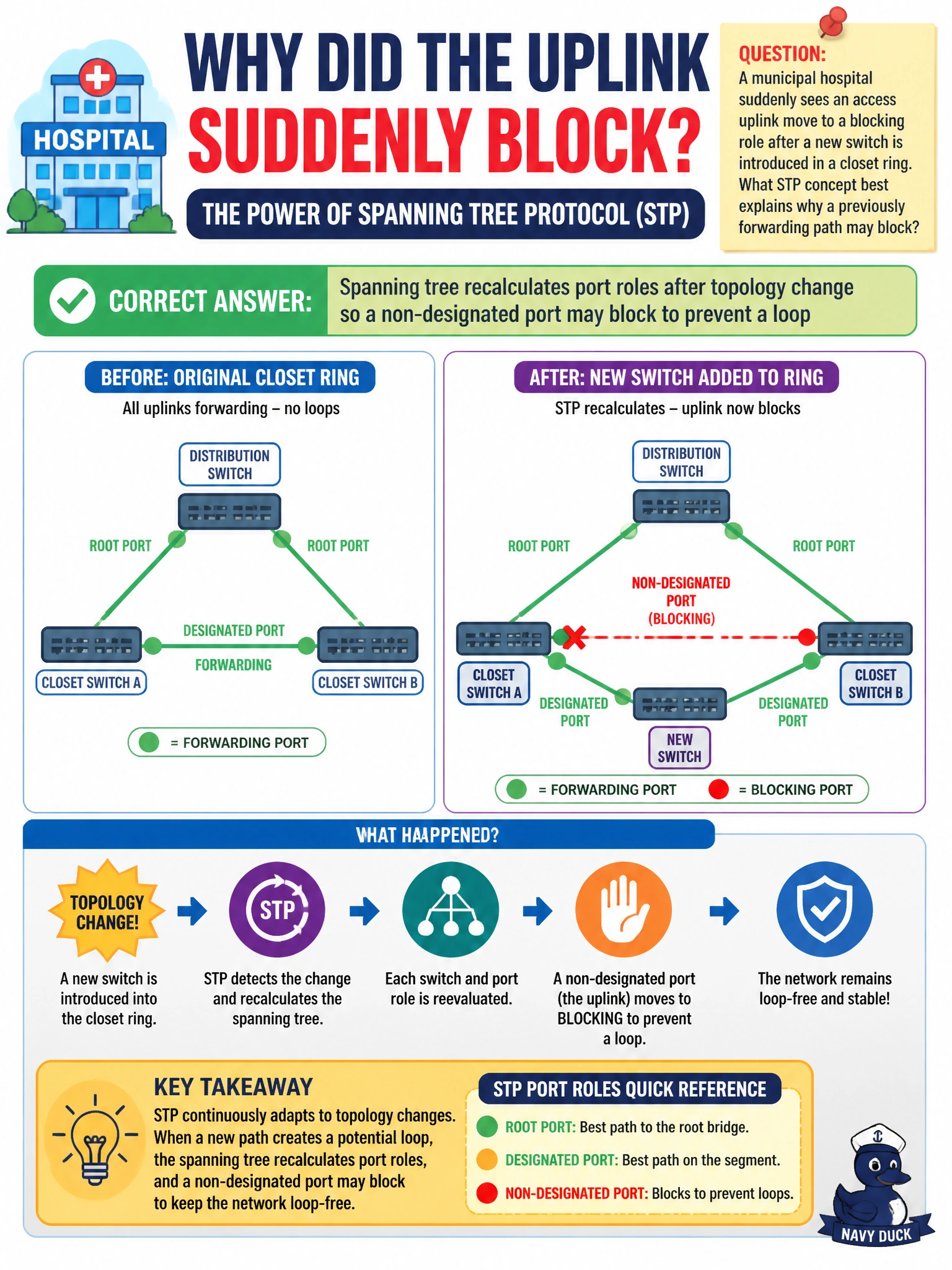
A municipal hospital suddenly sees an access uplink move to a blocking role after a new switch is introduced in a closet ring. What STP concept best explains why a previously forwarding path may block?
Select an answer to reveal the explanation.
Short Explanation
When the hospital ring changes shape, STP redraws the map—somebody has to sit in the penalty box (blocked) so you do not get a broadcast storm. That blocked port is usually doing its job.
Full Explanation
Spanning tree continuously elects a root and assigns port roles—root, designated, and non-designated/alternate (blocking or discarding). When municipal hospital closets gain a new switch in a ring, BPDUs change the view of the best path to the root. A port that previously forwarded may lose designated or root status and move to blocking so that only a loop-free active topology remains. That role recalculation after a topology change is the core STP concept explaining why a formerly forwarding uplink may suddenly block.
EtherChannel hashing always forcing one uplink into blocking regardless of BPDUs is false: hashing distributes frames on a Port-Channel; it does not assign STP blocking roles to independent uplinks. NAT overload on the core pruning Layer-2 forwarding paths confuses Layer-3 address translation with spanning-tree role selection. BPDU Guard converting distribution uplinks into routed ports during reconvergence invents behavior BPDU Guard does not perform—BPDU Guard err-disables edge ports that hear BPDUs; it does not convert links to routed SVIs as an STP reaction.
Exam caveat: Rapid STP can reconverge quickly, so the block may be brief or may persist if the new topology truly prefers another path. Distinguish intentional alternate-port blocking from err-disabled or cable faults. Also remember EtherChannel makes multiple physical cables one STP link; two non-channeled redundant links are two STP edges and one will block.
Operational check: before and after introducing the closet switch, capture spanning-tree root, port roles, and costs on the hospital VLAN; confirm the newly blocking port is an alternate/non-designated role rather than err-disabled; document the intended root and restore any accidental superior priorities.