
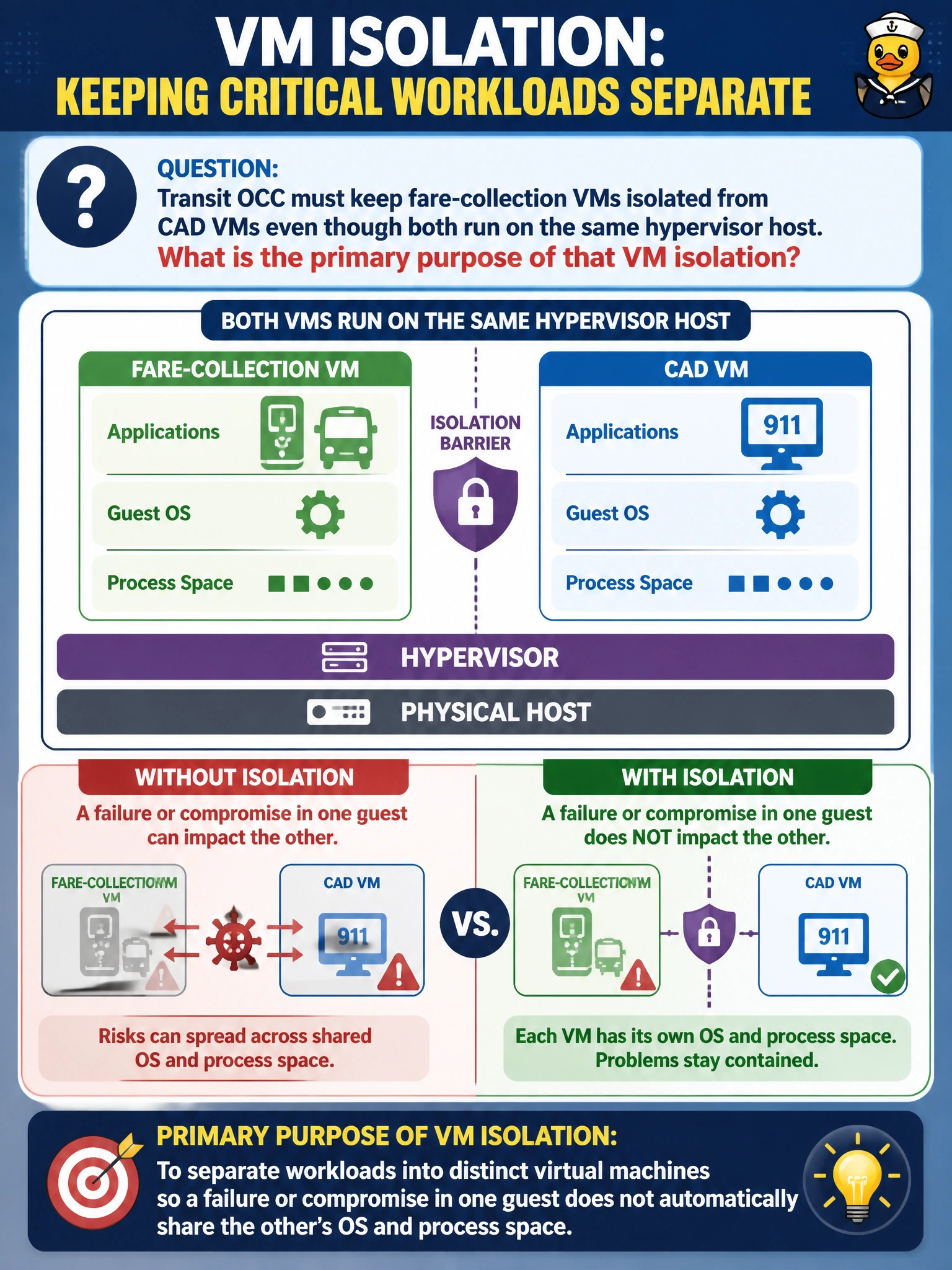
Transit OCC must keep fare-collection VMs isolated from CAD VMs even though both run on the same hypervisor host. What is the primary purpose of that VM isolation?
Select an answer to reveal the explanation.
Short Explanation
Two apartments in the same building still get separate locks. Fare and CAD VMs can share the hypervisor 'building' without sharing the same guest OS living room—that isolation is the whole point of carving separate VMs.
Full Explanation
VM isolation exists so distinct workloads can share a hypervisor host without sharing a guest operating system and process space. In a transit operations control center, fare-collection VMs and CAD VMs may run on the same host for efficiency, but isolation keeps a failure or compromise in one guest from automatically owning the other's OS environment. That separation of guests is the primary purpose tested at ENCOR depth for device/workload virtualization security and blast-radius control.
Forcing both workloads to share one guest kernel for faster failover destroys isolation and increases correlated failure risk. Disabling virtual switching so all VMs must use the same MAC address breaks basic virtual networking and identity. Replacing underlay routing with CAM aging on the hypervisor confuses campus Layer 2 aging with the purpose of guest isolation.
Exam caveat: isolation is about separate guest OS/process spaces, not about clever ways to merge kernels or MACs.
Operational check: place fare and CAD workloads in separate VMs with distinct virtual NICs/networks as required, verify policy between those segments, and test that a guest-level fault in one VM does not take down the other guest's OS.