
A courthouse campus evaluates SD-Access fabric and asks what the fabric control plane primarily contributes versus classic VLAN sprawl?
Select an answer to reveal the explanation.
Short Explanation
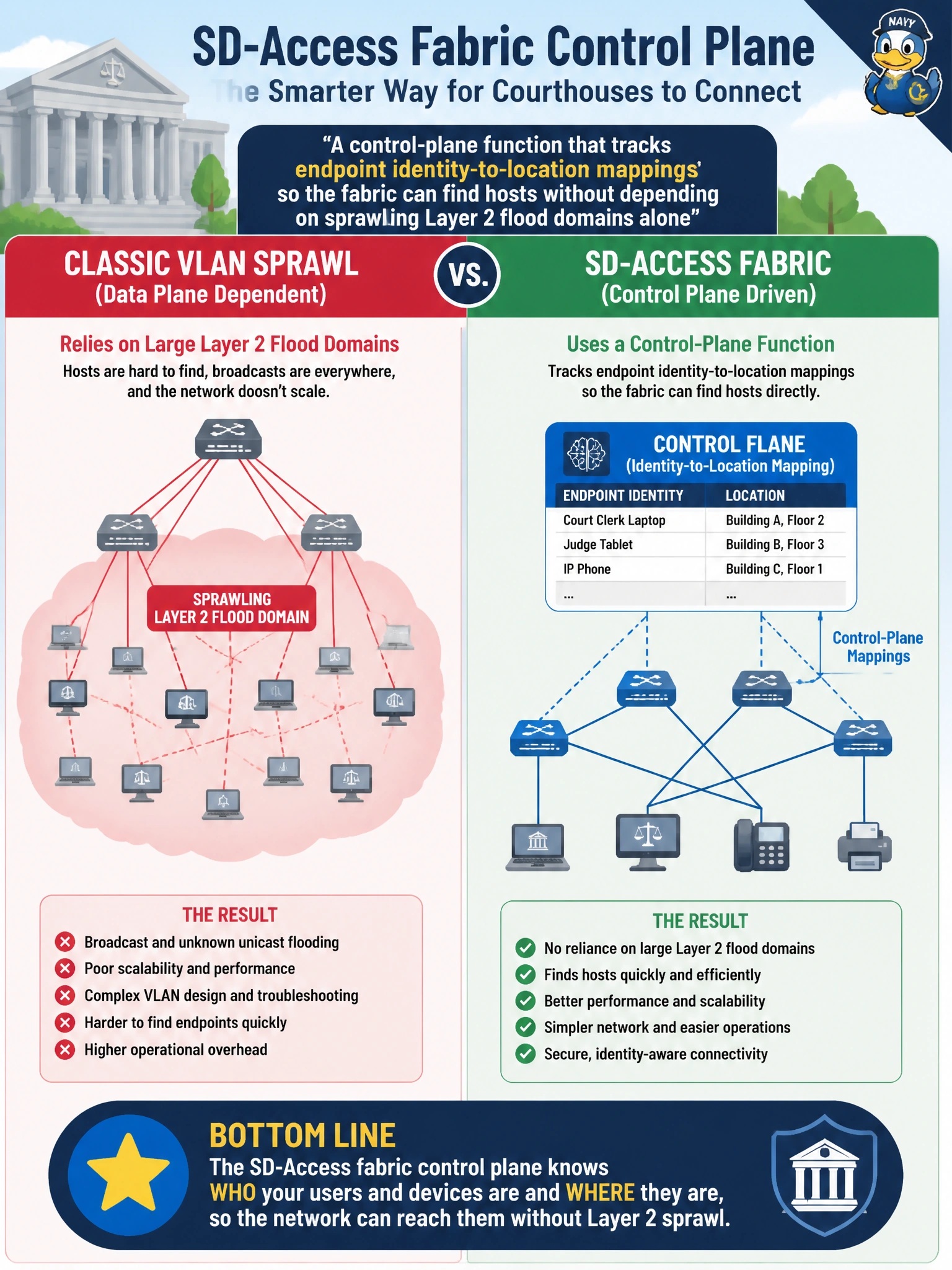
Classic VLAN sprawl is yelling a name through every hallway until someone answers. Fabric control plane is the directory service—identity mapped to location—so you look it up instead of flooding the building.
Full Explanation
A courthouse campus evaluating SD-Access fabric should understand that the fabric control plane primarily tracks endpoint identity-to-location mappings so the fabric can find hosts without depending on sprawling Layer 2 flood domains alone. Instead of extending VLANs everywhere and flooding to locate endpoints, fabric control-plane registrations (LISP-based fabric control concepts at ENCOR depth) map identity to location and guide forwarding decisions across the campus.
Requiring disablement of all routing and extension of every VLAN across the metro area is classic sprawl, the problem fabric control aims to reduce. A wireless-only DSSS encoder that replaces campus switching ASICs is not a fabric control-plane function. Mandating removal of border nodes so fabric edges peer only with unmanaged hubs breaks fabric architecture rather than explaining control-plane value.
Exam caveat: Fabric control plane = identity/location mapping; do not equate it with VLAN extension or RF encoding.
Operational check: verify endpoint registrations in the fabric control plane for courthouse users/devices, confirm east-west paths do not rely on campus-wide VLAN floods, and validate border node connectivity for outside prefixes.