
Housing authority engineers map vManage-class orchestration into the Cisco SD-WAN plane story at ENCOR depth. Where does that orchestration/management function fit?
Select an answer to reveal the explanation.
Short Explanation
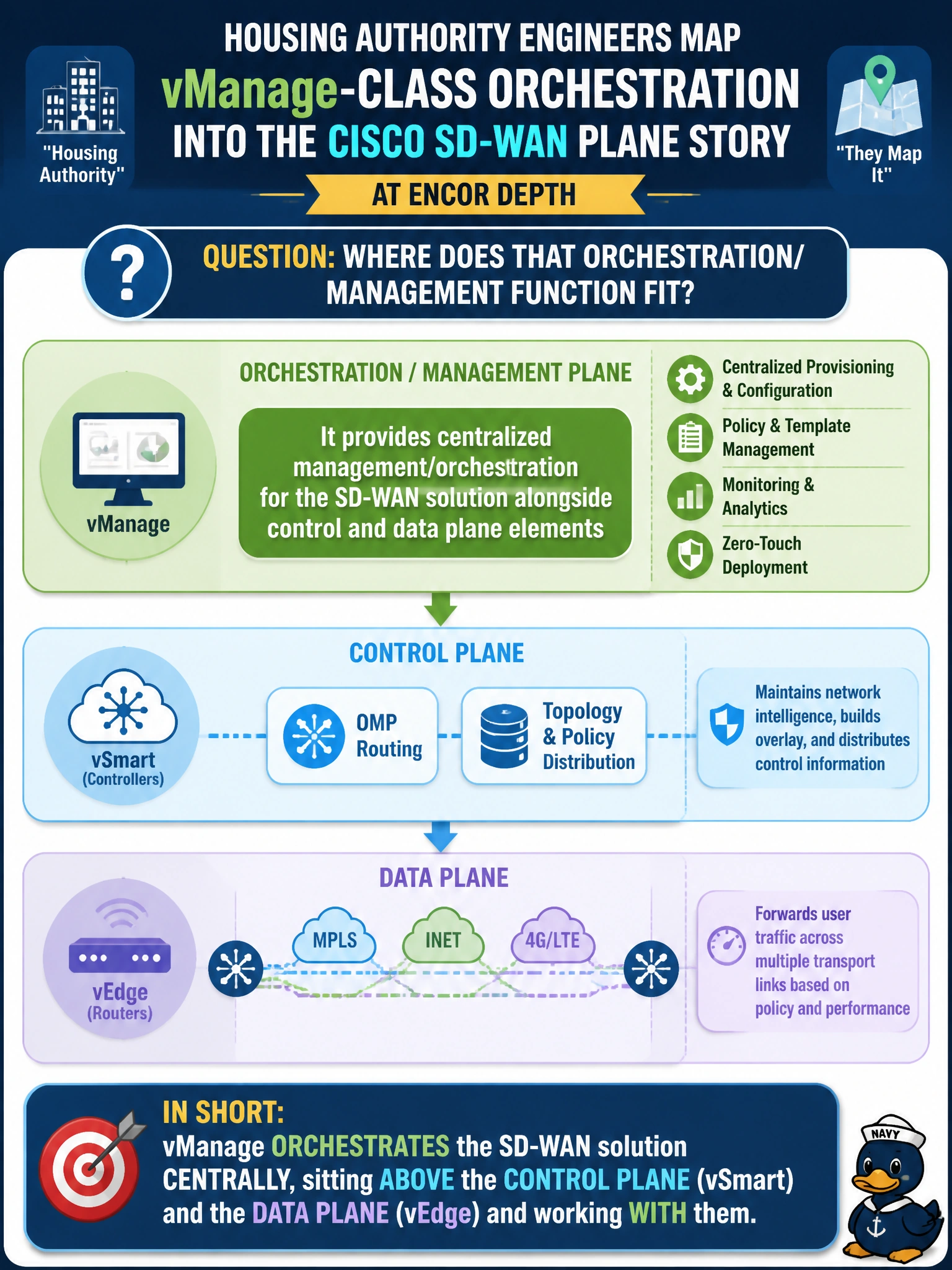
You can place vManage-style orchestration in centralized management alongside the control and data planes: it handles templates, visibility, and change control. Think of it as city planning—not the truck fleet, an encryption replacement, a TDM cross-connect, or a stadium location system.
Full Explanation
Housing authority engineers should place vManage-class orchestration in centralized management/orchestration alongside the control and data plane elements of the Cisco SD-WAN solution. This function provides templates, configuration, monitoring, and orchestration across the fabric; it coordinates and manages the solution rather than forwarding user traffic. Saying it replaces the need for any WAN edge data-plane encryption forever confuses management with security on the data plane: orchestration does not make encryption unnecessary. Saying it operates only as a Layer 1 TDM cross-connect between DSLAM ports describes an unrelated access or transport function, not SD-WAN management. Saying it exclusively performs client RF triangulation to estimate device locations in stadium Wi-Fi deployments confuses a WLAN location use case with SD-WAN orchestration. Keep the exam caveat in mind: ENCOR questions may use a three-plane story while also identifying management/orchestration, so distinguish management, control, and data functions instead of treating them as interchangeable. As a practical check, use vManage-class workflows for template pushes and visibility, verify that intended changes appear on the WAN edges, and separately validate that control connections and data-plane IPsec remain healthy after orchestration tasks.