
A port authority wants transport independence across LTE and broadband underlays using SD-WAN principles. What does that benefit mean?
Select an answer to reveal the explanation.
Short Explanation
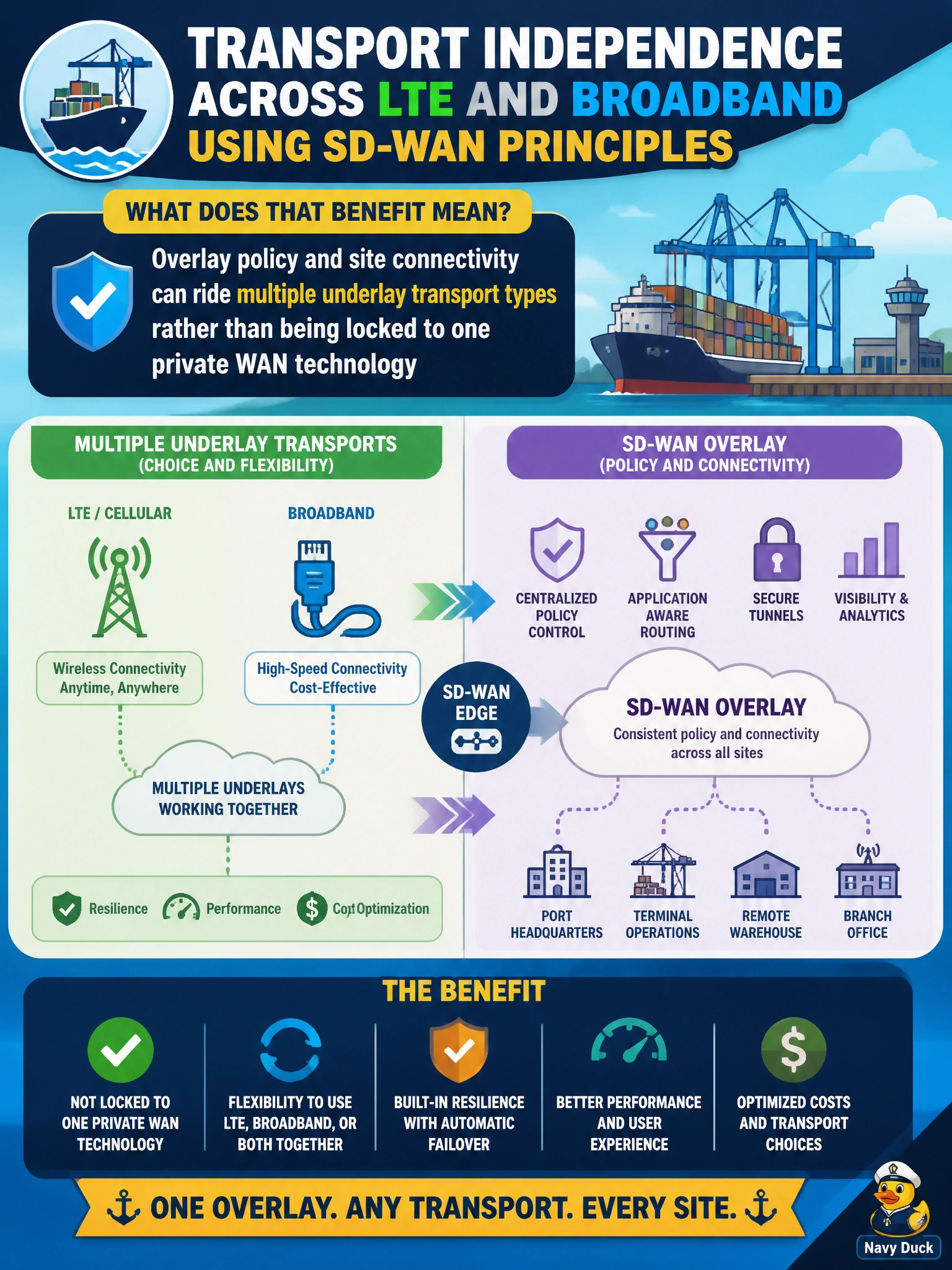
Independence means the ferry can use the bridge, the tunnel, or the water taxi—same passenger policy on top. SD-WAN overlays sit on LTE or broadband without worshipping one private WAN religion.
Full Explanation
A port authority wanting transport independence across LTE and broadband underlays using SD-WAN principles means overlay policy and site connectivity can ride multiple underlay transport types rather than being locked to one private WAN technology. The same centralized policy and overlay segmentation can use broadband, LTE, MPLS, or mixes thereof, so ferry terminals and port offices are not married to a single circuit type.
Requiring every underlay protocol to be identical Token Ring for overlays to form is historically nonsensical and false. Claiming LTE and broadband cannot be used unless MPLS is removed from the global Internet invents a false dependency. Defining transport independence as eliminating all encryption on untrusted underlays is dangerous and wrong—independence is about underlay choice, not abandoning overlay protection.
Exam caveat: Transport independence ≠ no encryption and ≠ single legacy LAN protocol; it means heterogeneous underlays under one overlay policy model.
Operational check: bring up dual underlays (for example broadband plus LTE) at a port site, apply the same overlay policy, fail one transport, and verify sessions follow remaining TLOCs without redesigning application policy.