
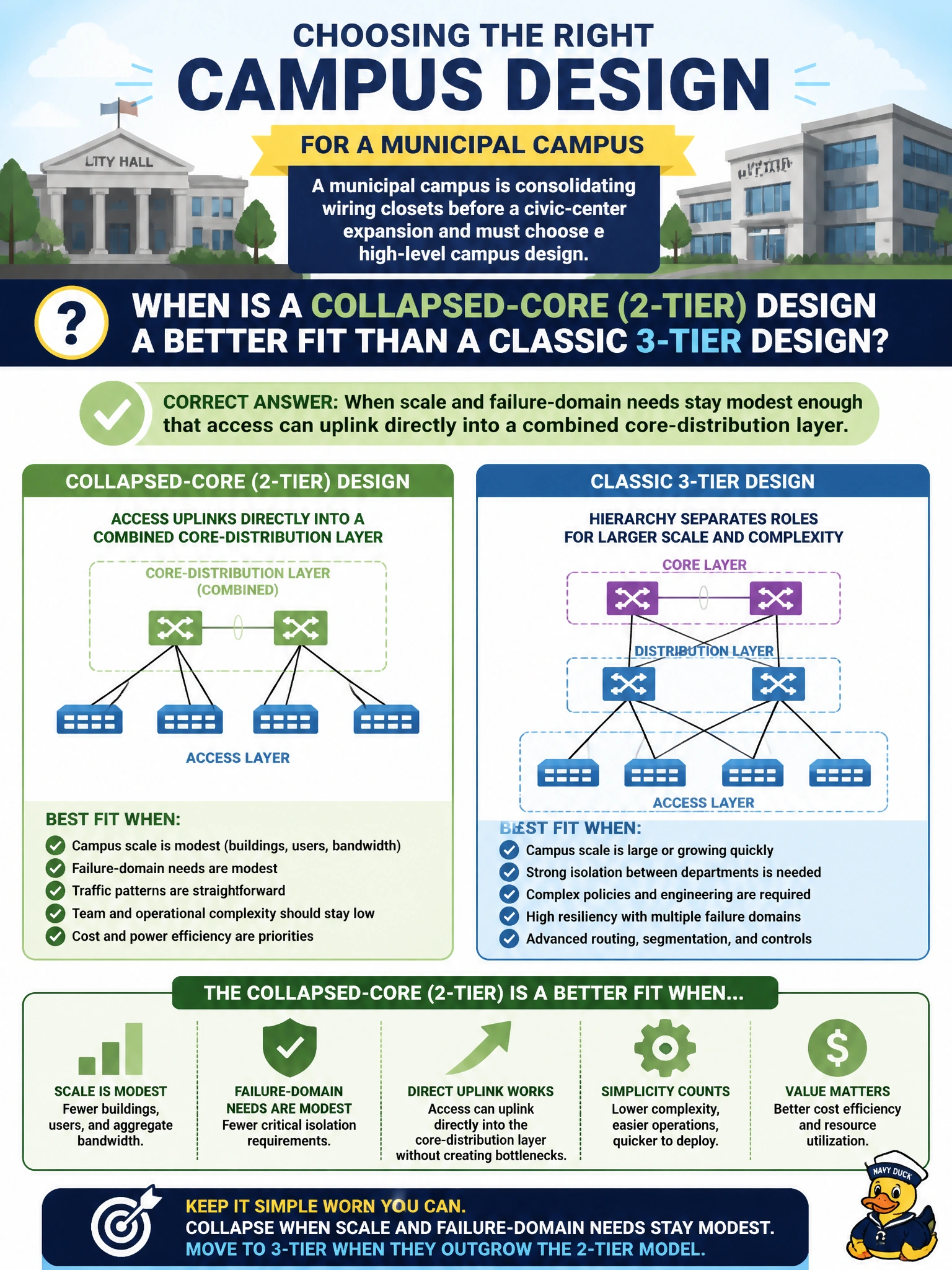
A municipal campus is consolidating wiring closets before a civic-center expansion and must choose a high-level campus design. When is a collapsed-core (2-tier) design a better fit than a classic 3-tier design?
Select an answer to reveal the explanation.
Short Explanation
Think of a small town hall versus a sprawling county campus. If the place is still compact, one combined core-distribution layer is like putting city hall and the dispatch desk in the same building—fewer hops, simpler. Once buildings and failure domains explode, you split them. Collapsed core wins when scale stays modest.
Full Explanation
A collapsed-core (2-tier) campus merges core and distribution functions so access switches uplink into that combined layer. For a municipal campus consolidating wiring closets ahead of a civic-center expansion, that model is the better fit when scale, port density, and failure-domain requirements remain modest enough that a separate dedicated core would add cost and complexity without delivering proportional isolation or east-west capacity. Access-to-combined-core-distribution uplinks keep the design compact while still supporting first-hop redundancy and Layer 3 boundaries at the distribution edge of the collapsed pair.
Isolating a core failure domain larger than the building count describes a growth or resilience need that usually pushes toward a classic 3-tier design, not collapsed core. Requiring a dedicated spine for east-west civic applications that cannot share distribution duties likewise signals that combined core-distribution is already overloaded or wrongly scoped. Mandating SD-Access fabric borders to replace all Layer 2 uplinks before any closet move confuses fabric migration sequencing with the high-level tier choice; fabric readiness is orthogonal to whether core and distribution are physically combined.
Exam caveat: ENCOR treats collapsed core as an appropriate hierarchical choice for smaller or mid-size campuses, not as a universal replacement for three-tier designs. Do not assume collapsed core is always cheaper in operations if troubleshooting blast radius becomes the civic risk driver.
Operational check: inventory access closet count, uplink bandwidth and oversubscription, east-west traffic between civic applications, and how large a single combined-layer outage would be. If those stay modest, collapsed core fits; if expansion will create many independent buildings with heavy east-west flows, plan the dedicated core tier instead.