
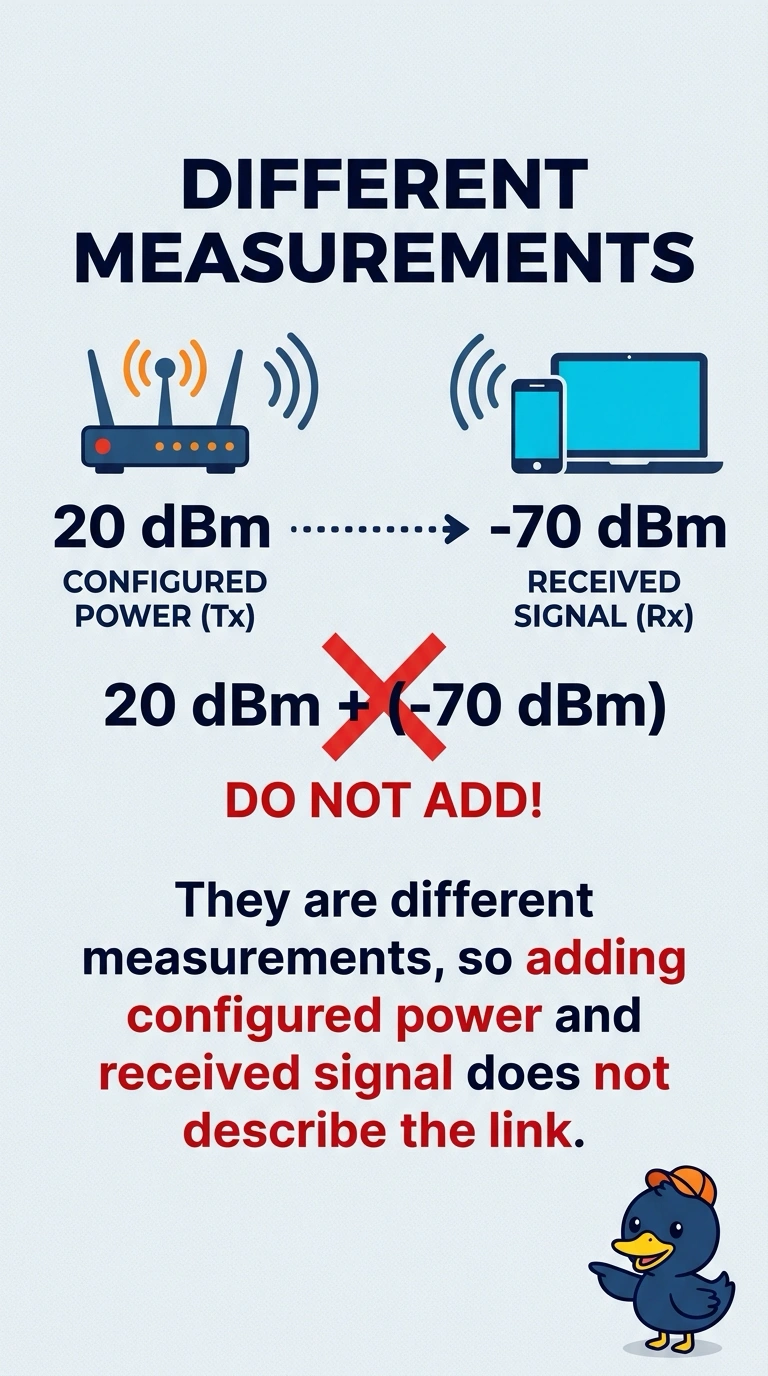
An access point is configured for 20 dBm, and a client at a desk hears it at -70 dBm. An engineer adds those two numbers and treats the sum as the link quality. What is wrong with that?
Select an answer to reveal the explanation.
Short Explanation
You’re comparing different measurements: the radio’s transmit setting and the signal that reached your desk. Adding them does not describe your link, and you should not expect the client to hear 20 dBm just because that is the setting.
Full Explanation
Configured transmit power is a setting at the radio; RSSI is what the client measured after the signal traveled to the desk. They are different measurements, so adding 20 dBm and -70 dBm does not describe the link or produce a useful figure. The sum is not SNR: SNR compares the received signal with the noise floor, not with configured transmit power. It is not the noise floor either; that is measured, not calculated by pulling a negative RSSI downward. Nor should the client hear 20 dBm just because that is the configured setting. That is the power at the antenna, not the power after the path to the desk. Exam caveat: a real link budget does add gains and subtract losses, starting with power and accounting for antenna gain, cable loss, and path loss; it does not add the client’s RSSI back onto the transmit setting. For a practical check, record configured power, antenna gain, and the client’s RSSI as separate readings. After a change, check one live client and leave the rest of the floor alone until that client matches the result you expected.