
A lab inserts a 6 dB attenuator between a radio and its antenna. About how much of the conducted power reaches the antenna?
Select an answer to reveal the explanation.
Short Explanation
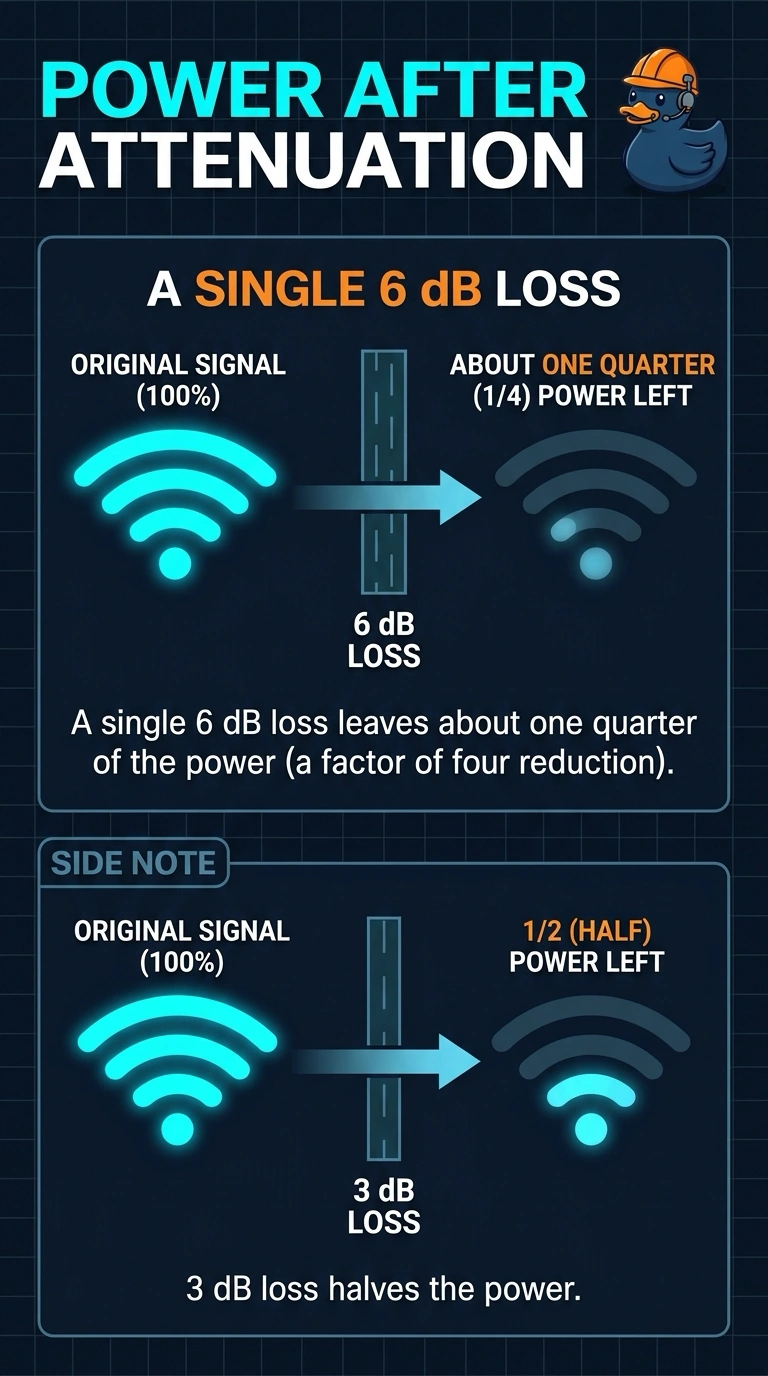
Three decibels cuts the power in half, and you just stacked that twice. Six decibels leaves about a quarter of the conducted power at the antenna. It is not a tenfold cut, and it is not a channel change.
Full Explanation
A loss of 3 dB leaves about half the power, and 6 dB is twice that many decibels, so it leaves about a quarter. The attenuator sits between the radio and the antenna, so about one quarter of the conducted power reaches the antenna. One tenth would be 10 dB, not 6 dB. Three decibels and six decibels are not the same cut. Half would be the 3 dB pad, not this one. An attenuator does not change the channel number. It reduces power on the way to the antenna. A 6 dB attenuator leaves about one quarter of the power. 3 dB is half, so 6 dB is half of that, a quarter. Not one tenth. Check one live client after the change and do not retune the rest of the floor until that client matches the result you expected. Exam caveat: the quarter is an approximation of the decibel rule, and the antenna then concentrates whatever arrives. Gain after the pad can raise EIRP in the main lobe and still cannot put back the power the pad removed in every direction. Operational check: read conducted power before and after the pad and expect the after reading to sit about 6 dB lower.