
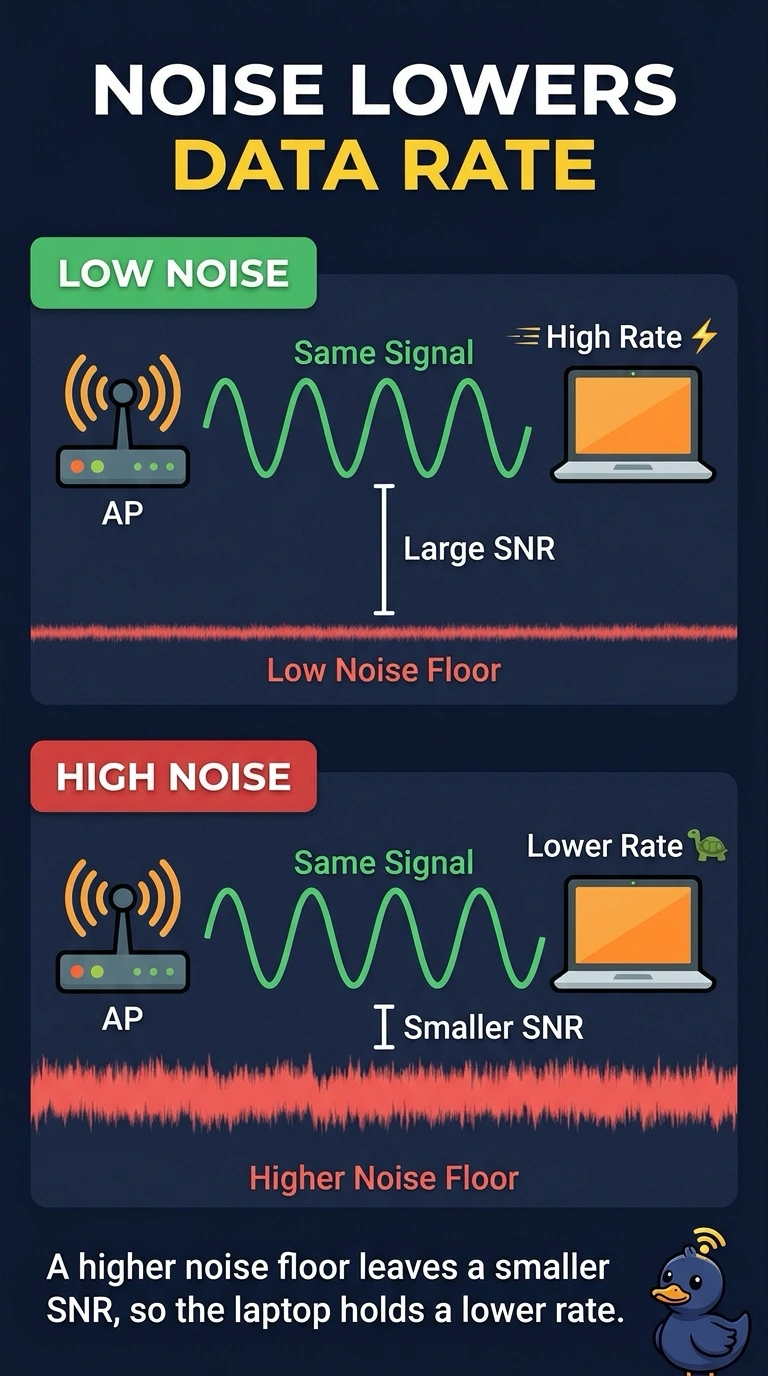
Two seats show the same received signal from an access point. The noise floor is much higher at the second seat, and the laptop there holds a lower rate. Why is the rate lower?
Select an answer to reveal the explanation.
Short Explanation
Same signal, more noise, smaller gap. Your laptop at the noisy seat cannot hold the rate the quiet seat can. The signals match and the SNR does not, and that gap is the rate.
Full Explanation
SNR is signal minus noise. The received signal is the same at both seats and the noise floor is higher at the second, so the SNR there is smaller. The higher rate needs the larger gap, and the laptop steps down. Equal signal does not mean equal SNR when the noise is different, and a lower rate with a working association is not a DHCP failure. Higher noise does not increase SNR. It shrinks it. A country code does not change because a noise floor changed. The regulatory setting is not a function of the interference at one seat. Equal received signal is not equal SNR when the noise floors differ. The noisier seat has the smaller gap and therefore the lower rate. Exam caveat: if the noise is a brief spike, a single reading will lie. Watch the noise and the rate together for a minute before you redesign the channel. Read the live result after the change, not only the object you edited. Operational check: read signal and noise at both seats and confirm the noisy seat's SNR, not its signal, tracks the lower rate.