
A Catalyst 9800 SSO pair keeps dropping its stateful relationship. The redundancy link rides a switch path that also carries client traffic and flaps several times a day. What should change?
Select an answer to reveal the explanation.
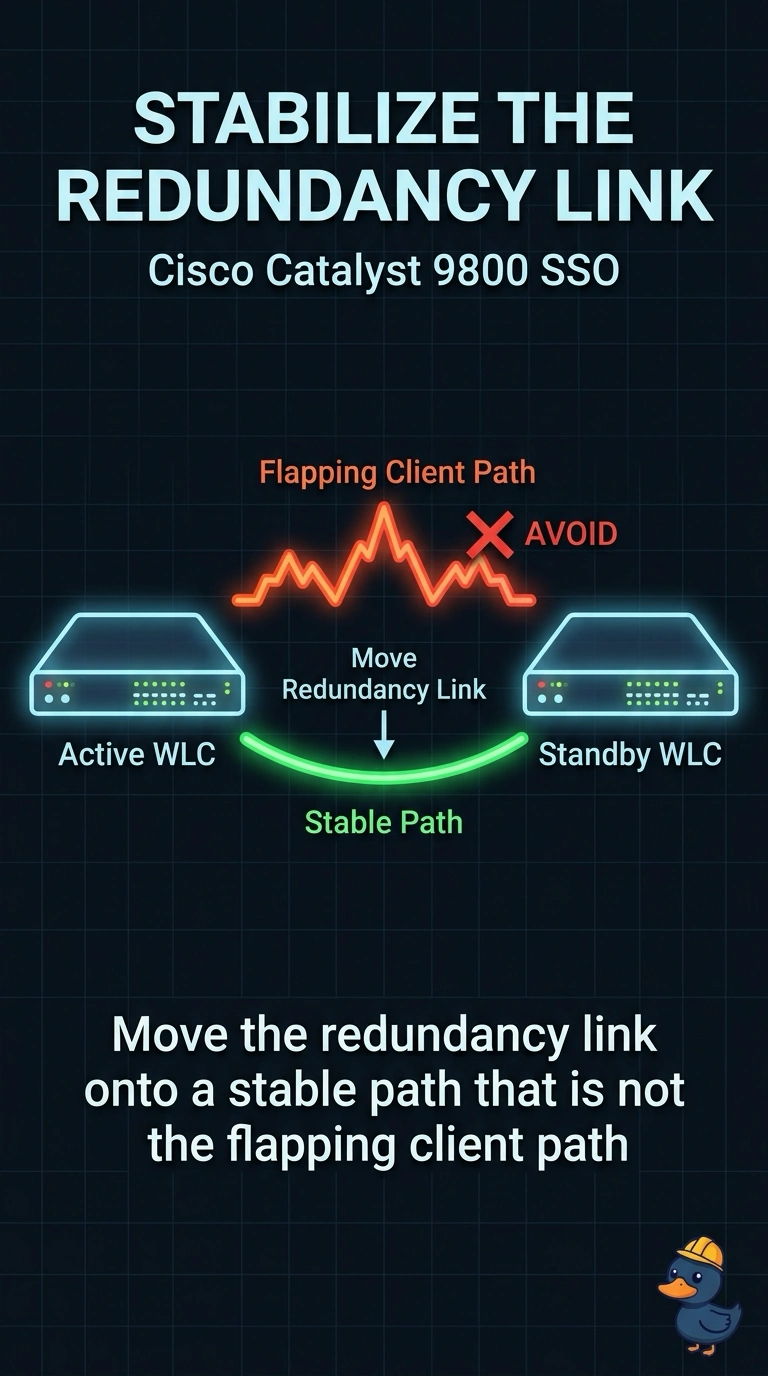
Short Explanation
The pair can only stay stateful while the link between them stays up. Your pair is sharing a path that falls over all day. Give that link a quiet path of its own, because hiding a name will not steady the wire.
Full Explanation
Stateful switchover needs a redundancy link that stays up. This pair's link rides a switch path that also carries client traffic and flaps, so the stateful relationship drops with every flap. Move the redundancy link onto a stable path that is not that client path. Hiding the employee SSID changes beacons. It does not stop a switch path from flapping or remove the redundancy link from it. The beacon interval does not filter link flaps, and a shorter beacon will not keep the pair in sync through a down link. The data rate is a radio setting. Lowering it does not make a flapping switch path safe to share with the redundancy link. Stateful failover only survives while that link stays up. A path that flaps with ordinary client traffic will keep tearing the pair apart. Exam caveat: a dedicated path that itself flaps is no better. The requirement is stability, not a particular VLAN number. Operational check: move the redundancy link, flap the old client path on purpose, and confirm the pair stays stateful.