
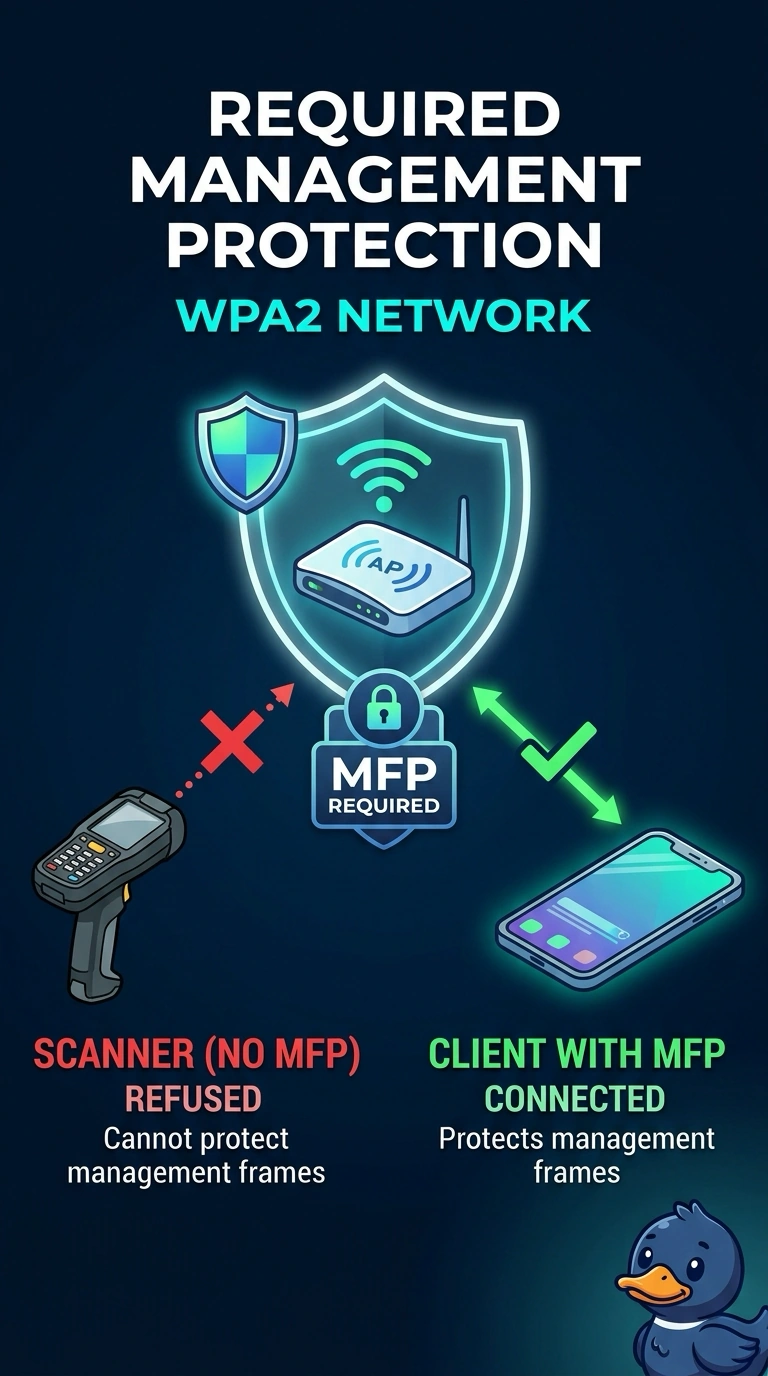
A WPA2 WLAN requires protected management frames. New phones join. Older scanners that cannot protect management frames never associate. What does the requirement do?
Select an answer to reveal the explanation.
Short Explanation
You’re requiring every client to protect management frames, so scanners that cannot do so are refused association while capable phones can join. Keep PMF required only if the devices you still own can support it.
Full Explanation
When protected management frames are required on a WPA2 WLAN, a client that cannot negotiate that protection fails association. The older scanners therefore do not get on, while the new phones that support protection can join; seeing a capable phone connect also confirms the WLAN is operating. The requirement does not let the scanners connect with only their data frames encrypted, because management-frame protection is required before association. It does not convert the scanners to open authentication; that would not give them the required protection. Hiding the SSID is unrelated to management-frame protection and would not selectively keep the scanners off while leaving phones able to join. Exam caveat: WPA3 expects protected management frames, whereas WPA2 makes them optional unless the WLAN administrator requires them; requiring them is what excludes these older scanners. For a practical check, watch one scanner fail to associate before it obtains a session, then confirm that a capable phone still joins. Verify the expected result on those clients before making any further WLAN changes.