
A lobby WLAN uses Enhanced Open. Guests join with no password and the frames are encrypted. A technician wants to add a pre-shared key so that encryption will start. What is the right response?
Select an answer to reveal the explanation.
Short Explanation
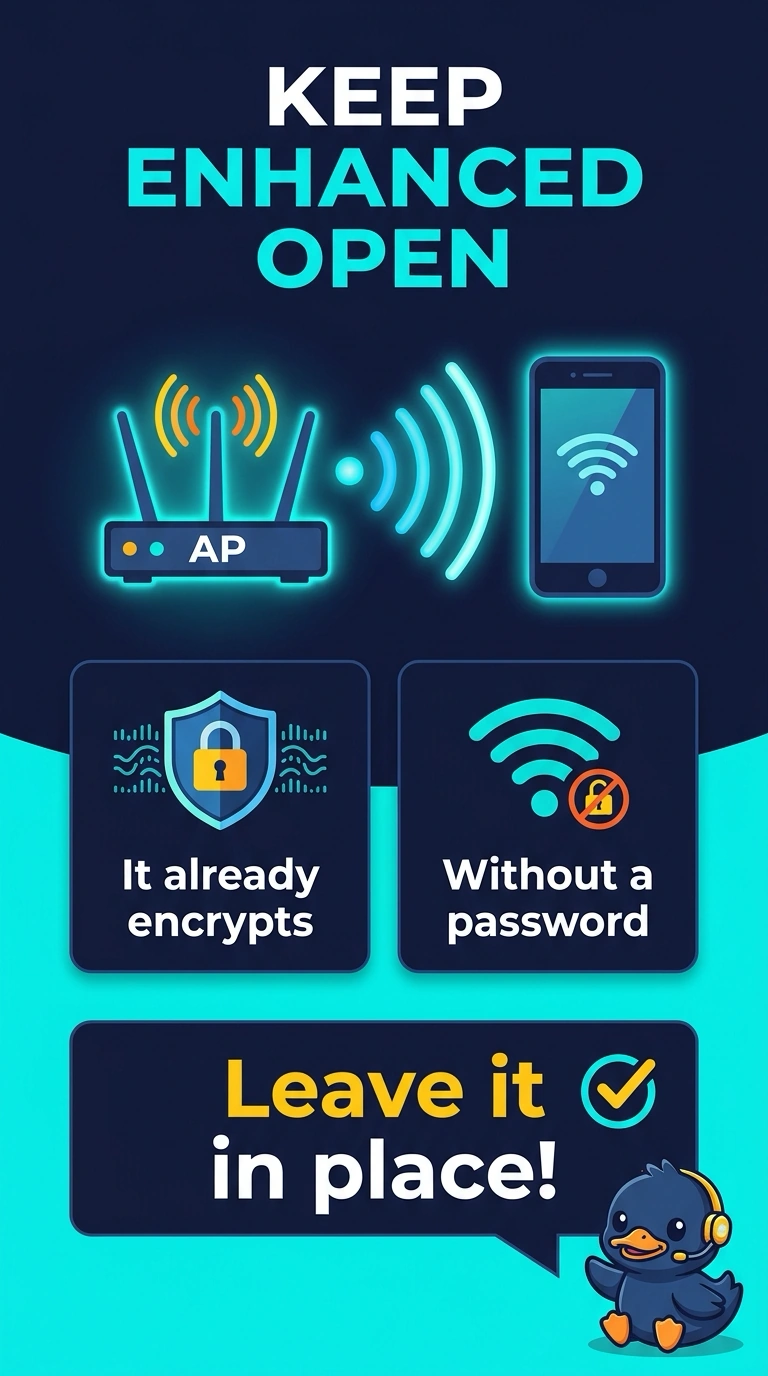
You already have encryption with Enhanced Open, even though guests join without a password, so adding a pre-shared key would change the security type rather than fix missing encryption. Leave it in place; hiding the SSID does not start encryption.
Full Explanation
Enhanced Open, also called opportunistic wireless encryption, encrypts wireless traffic without a password and without 802.1X. Because guests already join without a password and their frames are encrypted, adding a pre-shared key would replace the security type rather than fix a missing cipher. Leave Enhanced Open in place: it already provides encryption for this guest WLAN. The claim that Enhanced Open sends frames in the clear is the misconception. Hiding the SSID does not start encryption; it only conceals the network name. Lowering the data rate changes transmission behavior, not the WLAN’s security type, so it cannot turn Enhanced Open into a pre-shared-key network. Exam caveat: encryption does not identify or authenticate each guest. If the lobby later requires guest logins, that calls for a separate access-design decision, not a pre-shared key added to a WLAN that is already encrypted. Practical check: join with a test guest without entering a password, then confirm that the client session uses Enhanced Open and is encrypted.