
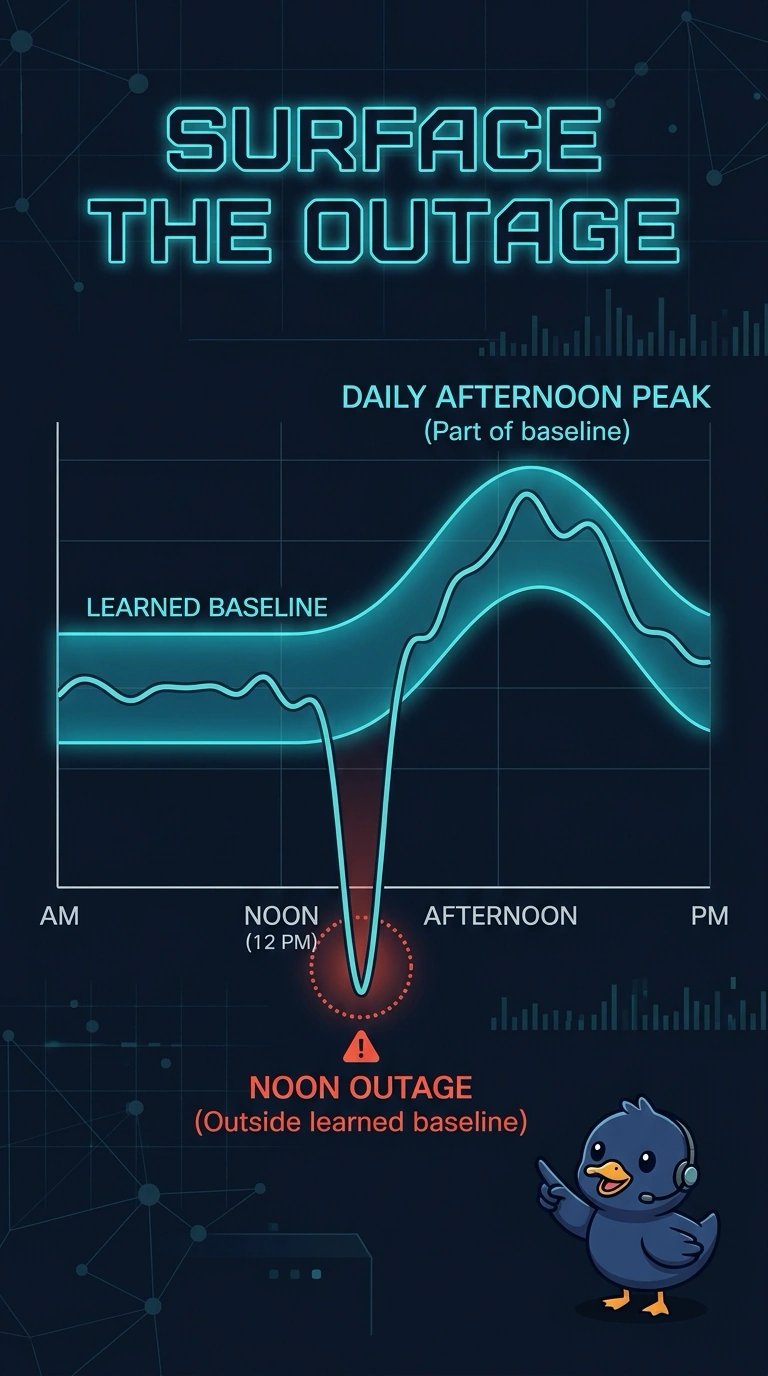
A site has a daily afternoon peak that matches the learned baseline, and today it also had a one-time noon outage the baseline has never contained. Which event should AI Operations surface?
Select an answer to reveal the explanation.
Short Explanation
You can trust the learned baseline: the daily afternoon peak is already part of it, while the noon outage is new. Surface the outage. When the regular peak stays quiet, your baseline is doing its job.
Full Explanation
AI Operations compares events with a learned baseline. The daily afternoon peak matches that baseline, so it is not the event to surface; the one-time noon outage has never been part of it, so it is the deviation to surface. A peak is not automatically an incident, and an outage that happens once is not automatically noise. The claim that neither event should be surfaced until a channel changes is wrong because a channel change is not required for AI Operations to identify an event outside the baseline. The claim that both should be paged treats every busy hour and every outage alike, throwing away the distinction the baseline provides. Instead, surface the noon outage and stay quiet on the regular afternoon peak. Check one live client after the change and leave the rest of the floor alone until that client matches the expected result; confirm the symptom on the next attempt before changing anything else. Exam caveat: if the noon window later becomes a regular closure, it belongs in the baseline and should stop paging. Until then, it remains the event to surface. Operational check: confirm that the noon outage is surfaced and the regular afternoon peak is not.