
A dorm floor has more 2.4 GHz radios than the clients need, and 5 GHz is congested. The radios can change role. Which AI-Enhanced RRM action fits?
Select an answer to reveal the explanation.
Short Explanation
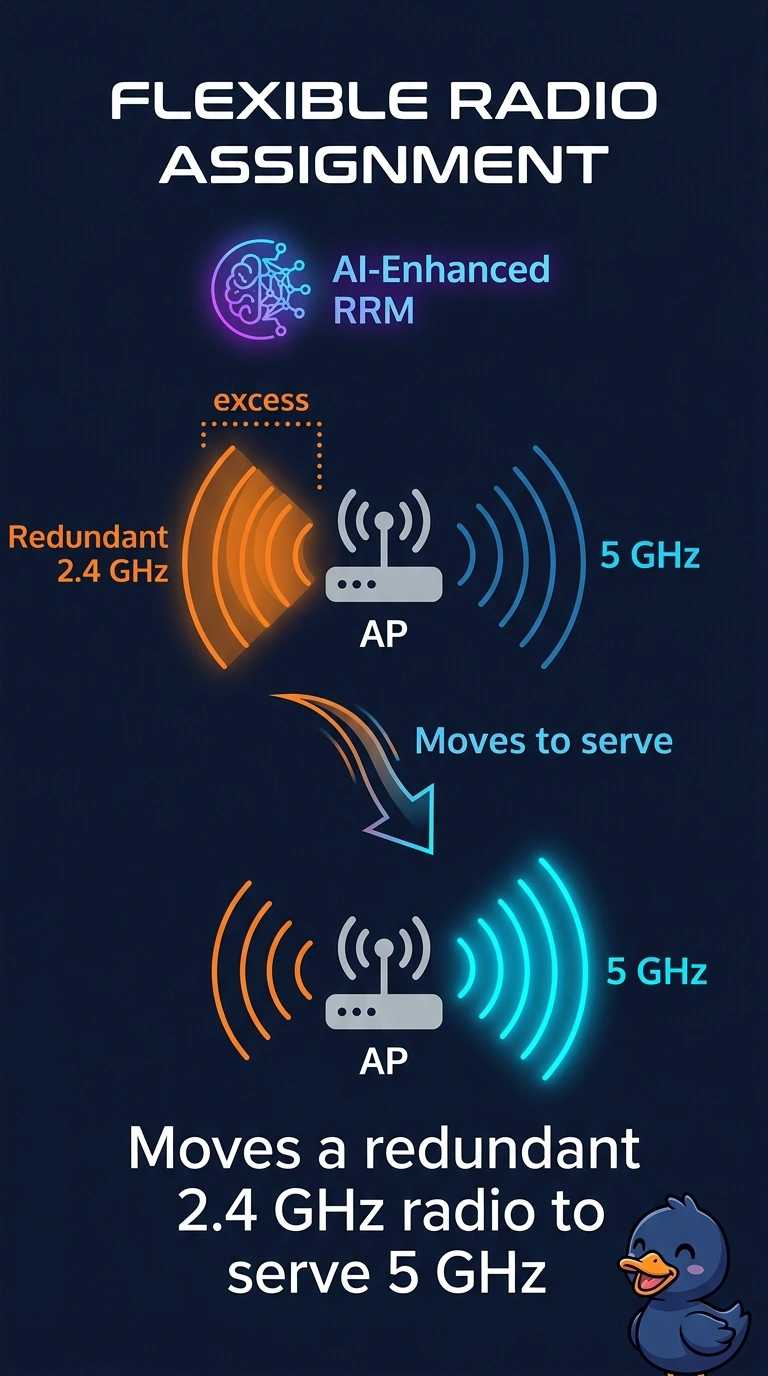
You have too many voices on 2.4 GHz and a crowd on 5 GHz, and the hardware can change jobs. AI-Enhanced RRM can move a redundant 2.4 GHz radio over to 5 GHz. A bigger DHCP scope does not add a radio.
Full Explanation
Flexible radio assignment, one of the optimizations AI-Enhanced RRM runs in the cloud, can change the role of a radio that is redundant on 2.4 GHz so it serves 5 GHz instead. That matches a dorm floor with spare 2.4 GHz coverage and a congested 5 GHz band, on hardware that can change role. A guest anchor does not convert a radio by moving a VLAN. DHCP scope size adds addresses. It does not add a 5 GHz radio or relieve airtime. A portal certificate does not retune bands. Renewing it leaves every radio on the band it already uses. Flexible radio assignment changes the role of a radio the hardware can retune. It does not add capacity by growing an address pool. Exam caveat: FRA does not invent radios the hardware does not have, and it should not strip 2.4 GHz if you still have devices that can use only that band. Look at the client mix before you celebrate a 2.4 GHz radio leaving. Operational check: confirm the floor is enrolled for AI-Enhanced RRM and that a redundant 2.4 GHz radio is recommended or moved to 5 GHz, then check that remaining 2.4 GHz coverage still sees the old scanners.