
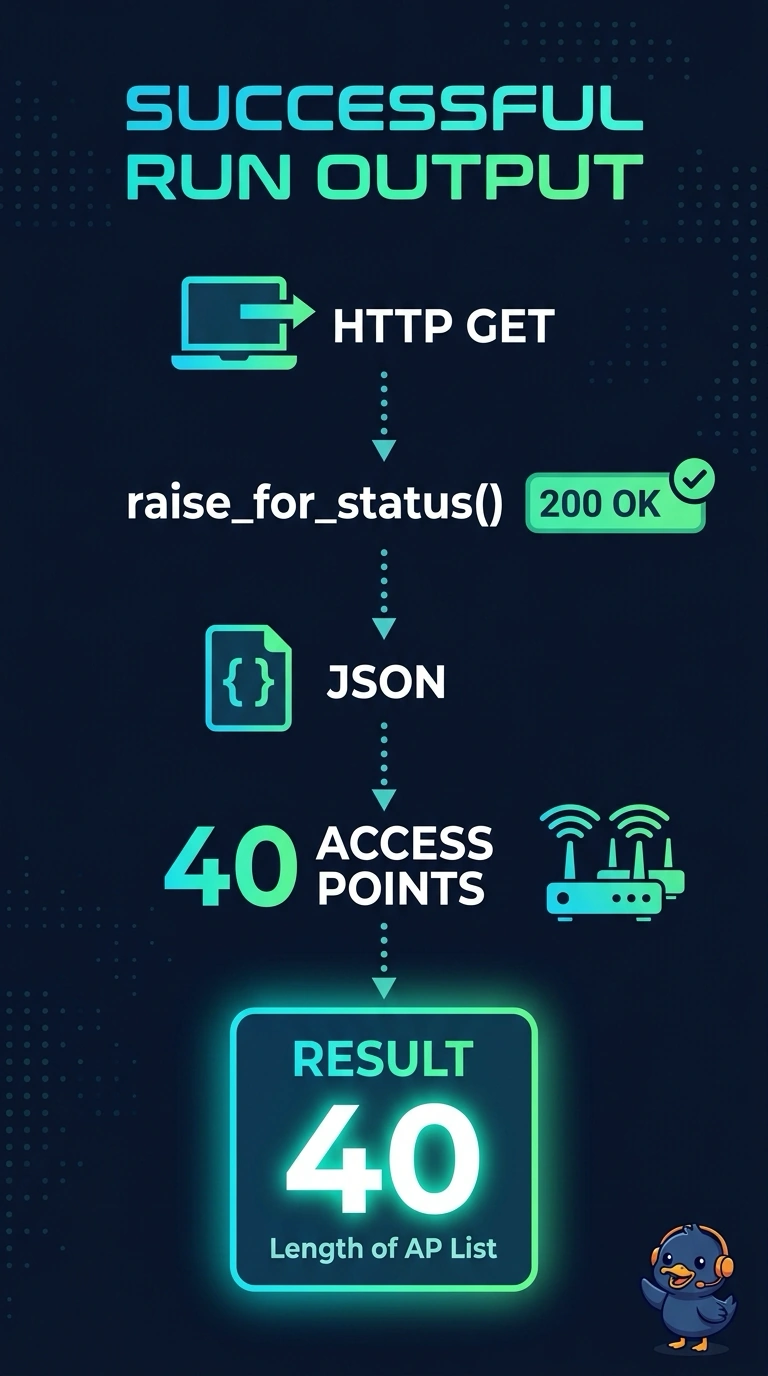
A SaaS script sends an HTTP GET, calls raise_for_status, then prints the length of the list inside the JSON response field. The server returns status 200 and a list of 40 access points. What does a successful run print?
Select an answer to reveal the explanation.
Short Explanation
Think of raise_for_status as a bouncer, not a printer: when the response is a clean 200, it steps aside. The next line prints the list’s length, so you see 40, not every access point’s hostname.
Full Explanation
raise_for_status raises an exception for an HTTP error status and returns normally for a successful status such as 200. After it returns, the script reads the JSON body, takes the list stored in the response field, and prints that list’s length. With 40 access points, a successful run therefore prints the single integer 40 and nothing else. The HTTP reason phrase is available on the response object, but the script never prints it, so it does not appear in place of the count. Printing every access-point hostname, each on its own line, would require a loop that writes each name; the described script only prints the length, leaving the hostnames inside the objects. A traceback would occur if raise_for_status raised an exception, but status 200 is successful, not an error, so treating it as a failed call reverses the method’s behavior. Exam caveat: a 200 response can still contain the wrong payload. If the list is under a different key from the one the script indexes, the status check succeeds but the later lookup raises a key error instead of printing 40. Practical check: run the script against a known inventory and confirm that the printed integer matches a manual count of that same list.