
A lecture hall access point transmits to several laptops at the same time, each on its own spatial stream. Which feature is that?
Select an answer to reveal the explanation.
Short Explanation
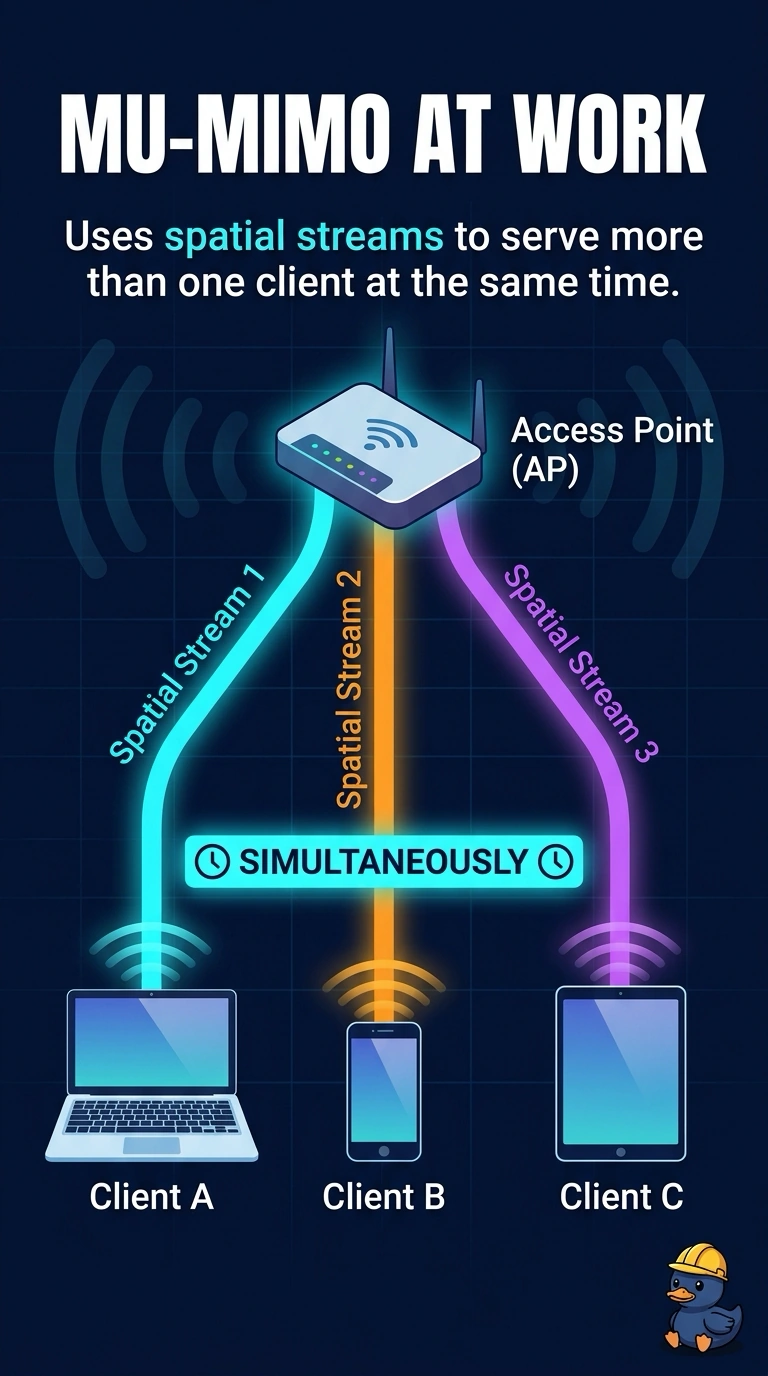
One transmission, several laptops, each with its own stream. That is multi-user MIMO. Your single-user MIMO spends the streams on one client at a time, and hiding the name does not split them.
Full Explanation
Single-user MIMO aims multiple spatial streams at one client. MU-MIMO aims streams at more than one client in the same transmission, which is what this lecture hall access point is doing. Single-user MIMO does not serve several clients at the same instant. A hidden SSID does not divide a stream. DFS is a radar response that can change a channel. It does not assign spatial streams. MU-MIMO sends spatial streams to more than one client at the same time. Single-user MIMO uses the streams for one client. Check one live client after the change and leave the rest of the floor alone until that client matches the result you expected. Exam caveat: the clients need enough separation and enough of their own streams for MU-MIMO to help. A room of one-stream phones may see little gain. The feature is still the multi-user one when the access point actually serves several at once. Operational check: read the access point's client view during the lecture and confirm more than one client is served in the same transmission.