
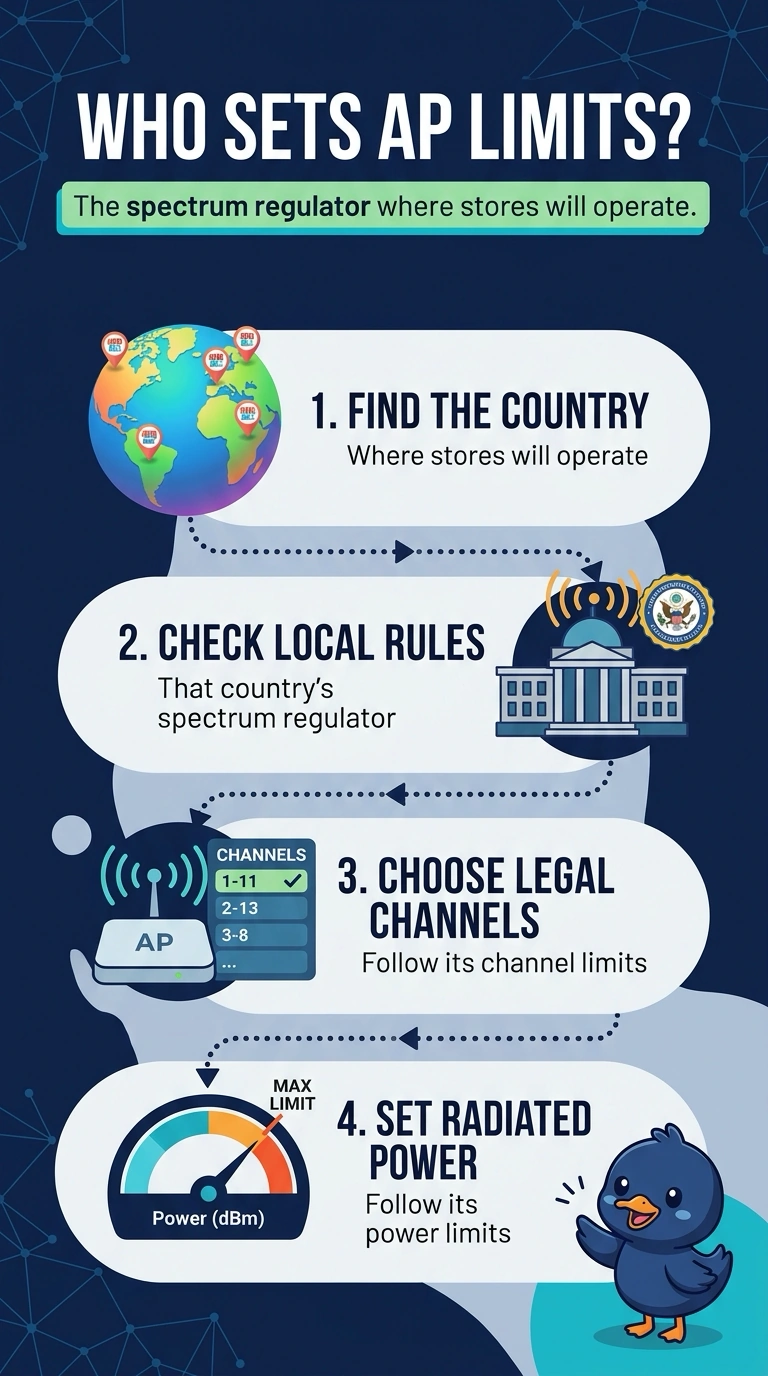
A retailer is opening stores in another country and must choose legal channels and radiated power for the access points there. Which body sets those limits for that country?
Select an answer to reveal the explanation.
Short Explanation
The speed-limit sign is posted by the country you are driving in, not by the people who wrote the car manual. Your store's legal channels and power come from that country's spectrum regulator. The logo on the box does not issue the license.
Full Explanation
Spectrum is allocated by each country's regulator, such as the FCC in the United States or an equivalent national authority elsewhere. That regulator decides which channels exist, whether a channel is indoor-only, and how much EIRP is legal. A retailer opening stores in another country has to build to that country's rules, then configure the wireless gear so it cannot exceed them. The IEEE 802.11 working group writes the technical standard: frame formats, PHYs, and amendments. It does not grant a license to radiate in a country. The Wi-Fi Alliance runs interoperability certification and the public generation and security marks. A certified product can still be illegal if you operate it on a channel or power that the local regulator forbids. The RRM leader only chooses among channels and powers the controller already considers allowed. It is an algorithm inside your network, not the source of the law. Exam caveat: a global product often contains several regulatory domains, and the configured country selects which of those tables is enforced. Operational check: set the country to the store's country and confirm the offered channel list matches that country's published plan before you mount access points.