
A hotel Survivability Gateway has no usable copy of user routing, and the sync of that routing has not succeeded. The cloud path is up tonight. What restores internal routing for the next outage?
Select an answer to reveal the explanation.
Short Explanation
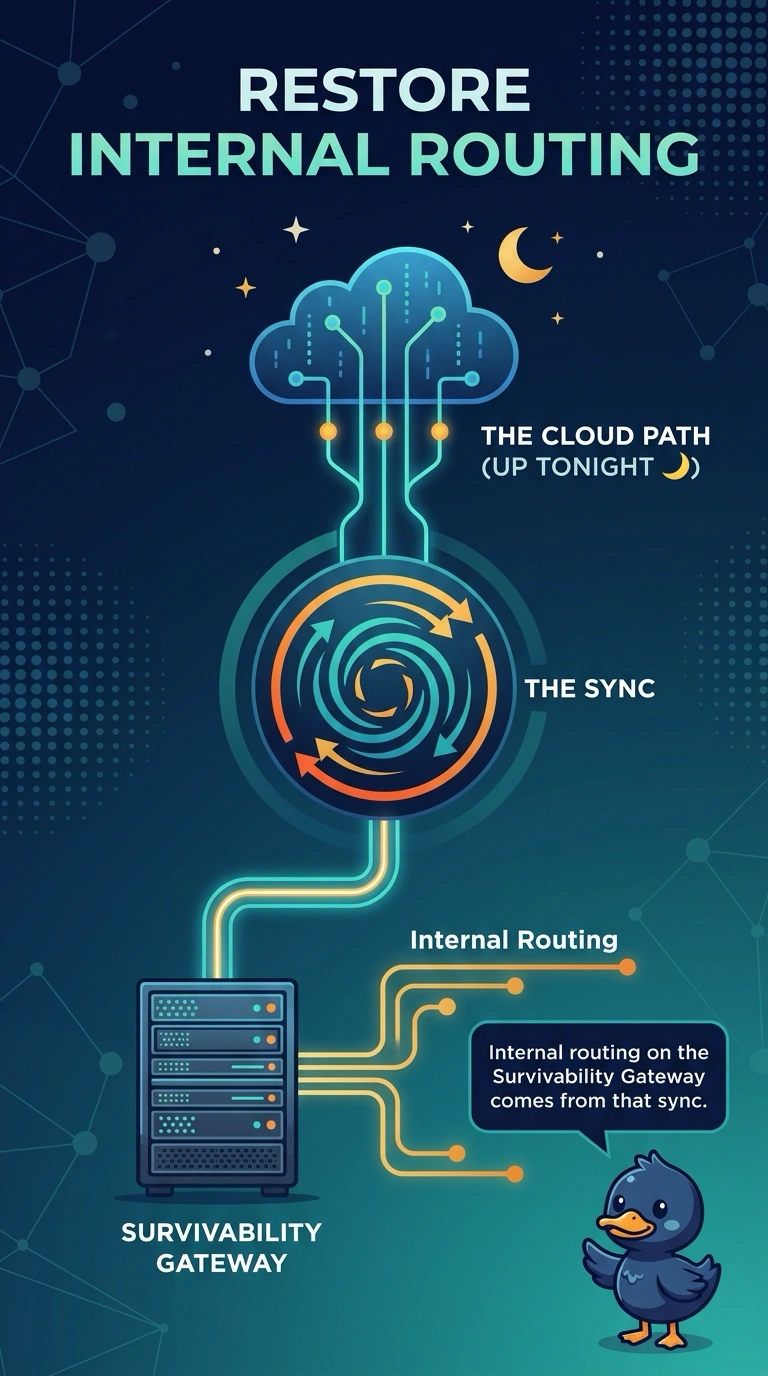
A spare map does not draw itself the night the highway closes on you. Internal routing on the Survivability Gateway comes from the sync, and that sync has not succeeded, so you restore it while the cloud is up. A macro cannot invent the map.
Full Explanation
Internal routing on a Survivability Gateway comes from the sync. This hotel gateway does not have that copy, and the cloud path is up, so the sync has to succeed before the next outage. The sync while the cloud is up, because internal routing on the Survivability Gateway comes from that sync. A device macro that invents the extensions, because a macro on a lobby board can build the gateway routing table during the next outage. A macro runs on a device and uses the xAPI. It cannot invent the user routing the gateway was supposed to learn from the sync. A public DNS SRV record for a certificate-based trunk, because user routing is learned from that SRV lookup on every outbound call. A public DNS SRV record helps a certificate-based local gateway show a trunk online. It does not deliver the survivability routing table. Hot desking on every front-desk device, because a Webex sign-in writes the backup dial plan onto the gateway. Hot desking is a person signing into a shared Board or Desk device. That sign-in does not write the backup dial plan. Exam caveat: A sync attempted only after the cloud path has already failed cannot fill in routing that was never copied. Operational check: With the cloud path up, complete the routing sync to the hotel Survivability Gateway and confirm it holds an internal test pattern before you rely on it in an outage.