
Two plants at a factory company call each other by extension, and those calls go out the PSTN and back in. The advanced dial plan has no internal route between the sites. What should be added?
Select an answer to reveal the explanation.
Short Explanation
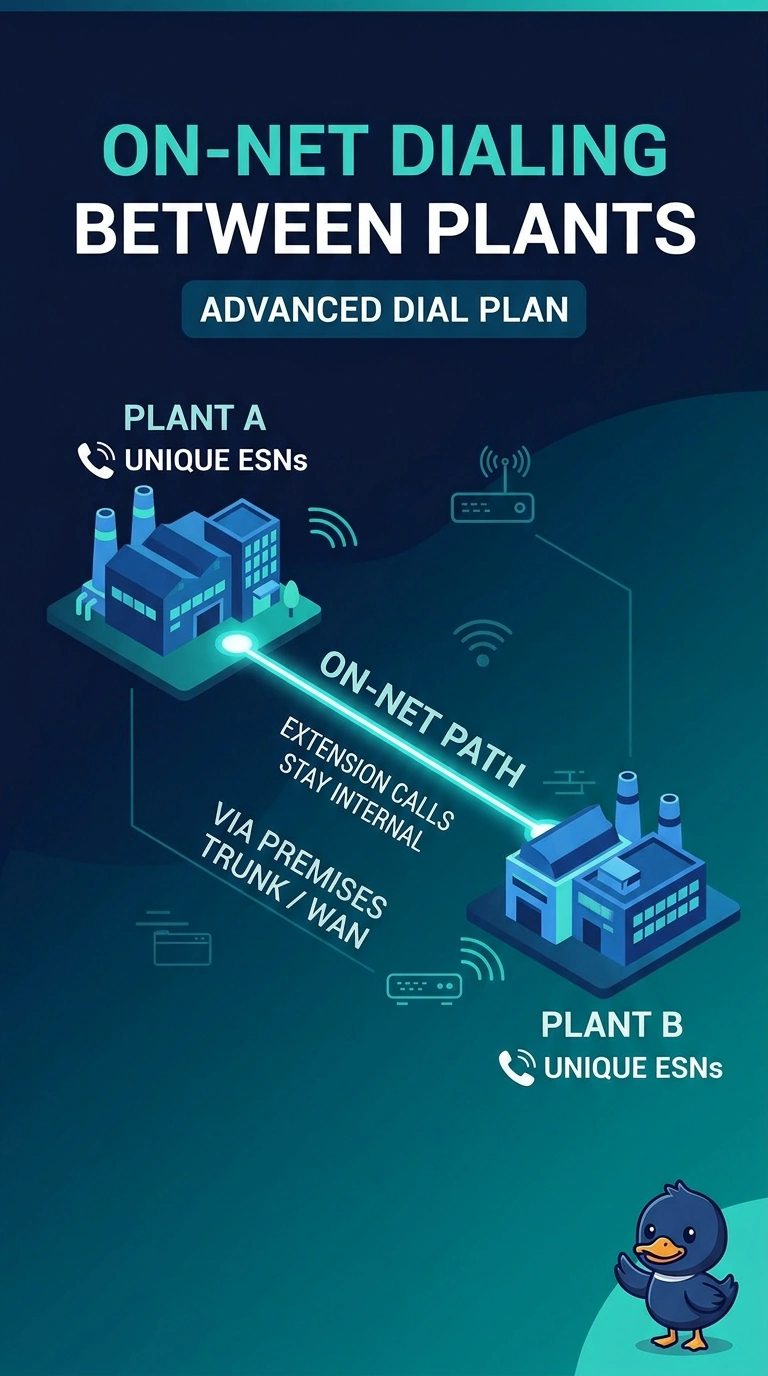
Two plants with a private road between them should not make you mail every note through the public post office. Extension calls are taking the PSTN because the advanced dial plan has no on-net path, so you add that internal route. A looser international permission does not build the private road.
Full Explanation
The advanced dial plan has no internal route, so a valid extension leaves on the PSTN and comes back in. Add on-net dialing so those calls stay internal and each plant keeps its own routing. Configure on-net dialing for the plants using unique enterprise significant numbers, or route the private numbers through the appropriate premises trunk for a mixed deployment. A looser international call permission, because an on-net extension call is classified as international until that class is allowed. The calls are already completing, so this is not a blocked call type, and a permission does not create an internal route. A new auto attendant at each plant, because a spoken menu is what keeps site-to-site calls off the PSTN. An auto attendant plays a menu and does not keep extension calls between plants off the PSTN. A directory resync of the plant users, because user objects are what select the PSTN trunk for an extension call. A directory resync updates users and does not choose the trunk an extension uses between sites. Exam caveat: A translation that works at one plant can strip digits the other plant still needs, so the on-net pattern has to fit both locations. Operational check: Place an extension call from one plant to the other and confirm it uses the on-net path with no PSTN trunk in the call, while international permission stays unchanged.