
Two television towers already share a trusted private microwave, and the routing protocol between them needs multicast. Encryption is not the requirement. Which tunnel design fits?
Select an answer to reveal the explanation.
Short Explanation
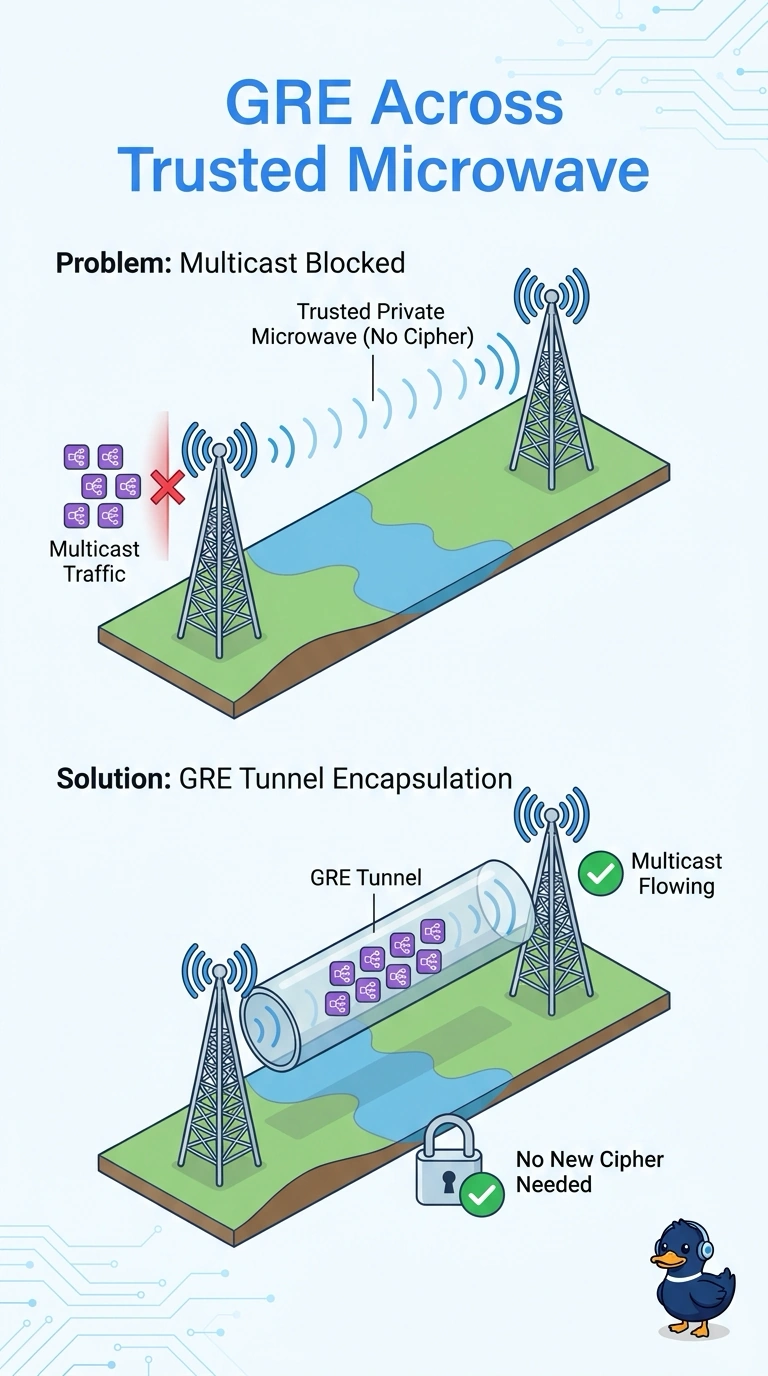
You already have a trusted private path, so you need a plain tunnel to carry the routing traffic it does not support. GRE lets multicast routing cross the microwave without adding a cipher. IPsec encryption, SD-WAN steering, and treating provider MPLS as a cipher do not address this need.
Full Explanation
The microwave is already private, and the missing piece is encapsulation that carries multicast routing between two fixed sites; GRE provides this without acting as a cipher. IPsec is designed to protect traffic, but encryption is not required here, and an IPsec tunnel alone does not provide the multicast overlay the microwave needs. SD-WAN steers traffic among transports or according to application needs, but the towers have one path and one traffic class, so that steering adds no value. Provider MPLS is a forwarding service, not a cipher, and it is not the private microwave already in use. GRE between the towers therefore meets the requirement by carrying multicast routing across the trusted microwave without adding encryption. Exam caveat: If a later requirement says the microwave provider must not see routing payloads, add encryption around GRE rather than discarding the multicast encapsulation. Practical check: In a lab using the microwave, confirm that the routing protocol forms an adjacency through GRE and that a packet capture shows multicast hellos; this design requires no cipher.