
A film studio bought a private interconnect to its cloud region for capacity. The interconnect does not encrypt the frames, and the studio requires confidentiality on that path. Which design supplies the encryption?
Select an answer to reveal the explanation.
Short Explanation
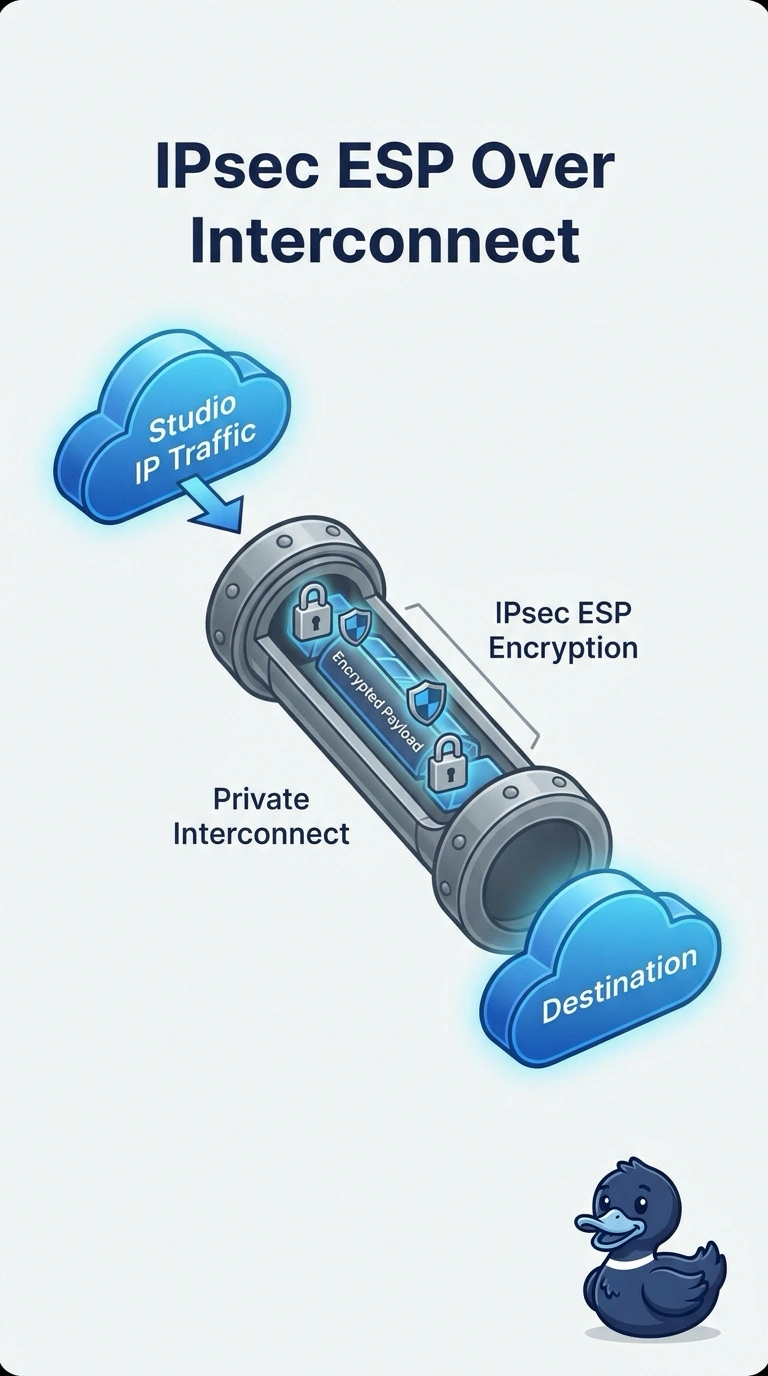
You can think of the private interconnect as a private road, not a locked case in the truck. Keep that route and use IPsec to encrypt the frames. The interconnect alone, GRE encapsulation, and steering across two internet carriers do not encrypt frames on this path.
Full Explanation
The private interconnect gives the studio a private route and capacity, but it is not an encryption service, so frames can remain readable on the provider side of that path. An IPsec tunnel encrypts the frame payload over the interconnect while preserving the private route, meeting the studio’s confidentiality requirement. ESP tunnel mode encrypts the original IP packet; the outer packet and link headers still carry the tunnel traffic. Treating the private interconnect alone as an encryption service fails because a dedicated route does not itself encrypt the studio’s frames. A GRE tunnel that encapsulates the frames but leaves the payload readable fails because encapsulation adds a header and tunnel without providing confidentiality. Per-application steering across two internet carriers fails because it selects a path for traffic rather than encrypting frames on the interconnect the studio has. Exam caveat: Capacity and privacy are separate requirements; buying a private interconnect for capacity does not satisfy a requirement to encrypt traffic on it. Practical check: Capture traffic on the interconnect and confirm the frames appear as encrypted IPsec tunnel packets; a GRE-only capture should still show readable payload.