
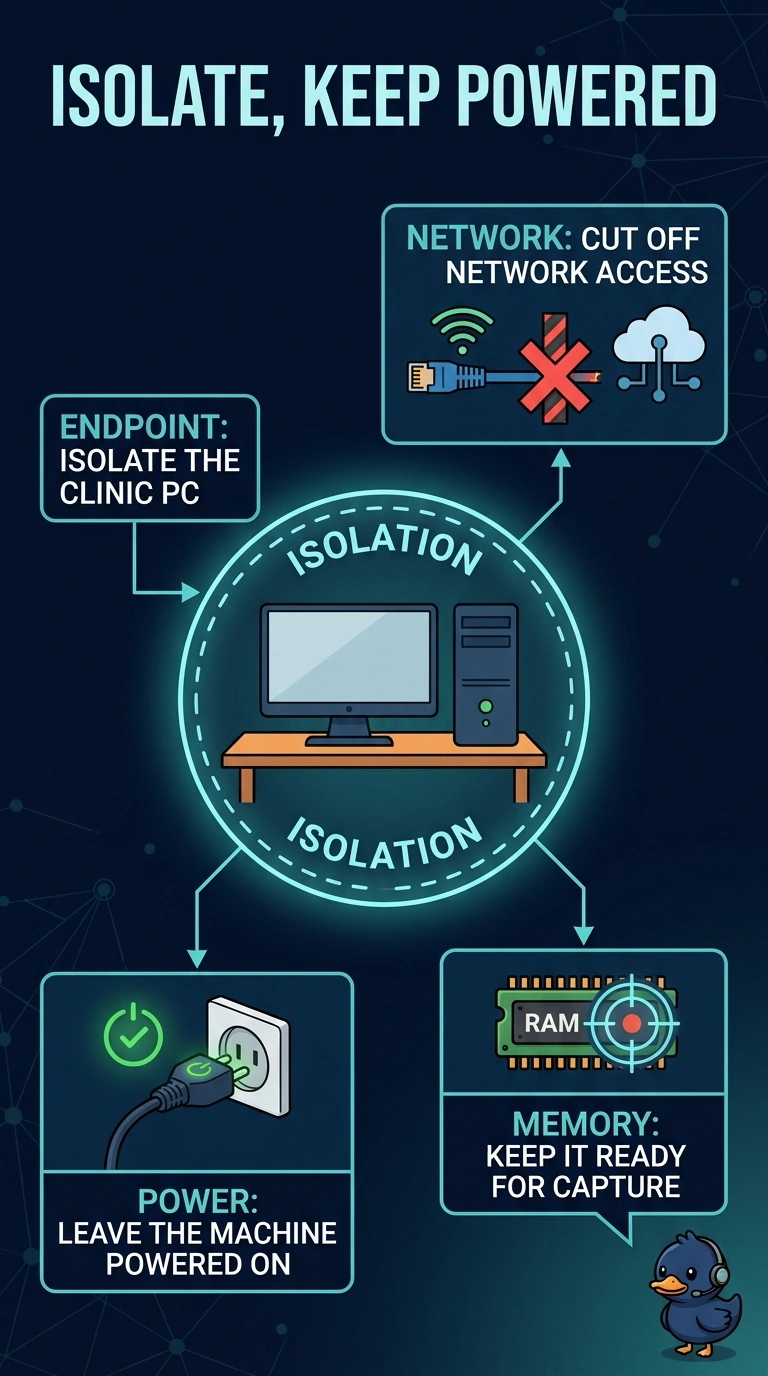
A clinic billing PC is beaconing to an unfamiliar host and is still on the office network. Investigators need it powered so memory can be captured. Which endpoint action fits?
Select an answer to reveal the explanation.
Short Explanation
A noisy phone should come off the hook and still keep the voicemail. You isolate the billing PC from the network and leave it powered. A cryptographic erase, a posture gate for roaming laptops, or a separate administrator workstation does not do both.
Full Explanation
The PC is on the network and talking to an unfamiliar host, and the investigation needs the machine powered so memory can be captured. Endpoint isolation limits network connectivity while the system stays powered. Cryptographic erase targets storage keys and could make disk evidence unreadable. A posture gate for roaming laptops and a separate administrator workstation do not stop this beacon. Endpoint isolation that cuts the PC off the network and leaves the machine powered on is the design that meets this requirement. A remote cryptographic erase that wipes the disk and the memory the investigators still need is the wrong fit because cryptographic erase targets storage keys and could make disk evidence unreadable. A posture gate written for laptops that are off the network, not this on-site billing PC is the wrong fit because a posture gate for off-network laptops does not stop a PC that is already beaconing on the office network. A dedicated administrator workstation for staff who do not log in to this billing PC is the wrong fit because a dedicated administrator workstation is a different machine, and it does not cut this billing PC off the network. Exam caveat: Isolation should block the beacon and still permit the investigator's approved capture path, or the team will disable isolation just to collect memory. Operational check: In a lab, confirm a beaconing test PC loses its general network access when isolated, stays powered, and still permits the approved capture session.