
A payments host lets each tenant set a pod label such as payments-ok, and any pod with that label can call the payment service. Which control stops a tenant from minting that access?
Select an answer to reveal the explanation.
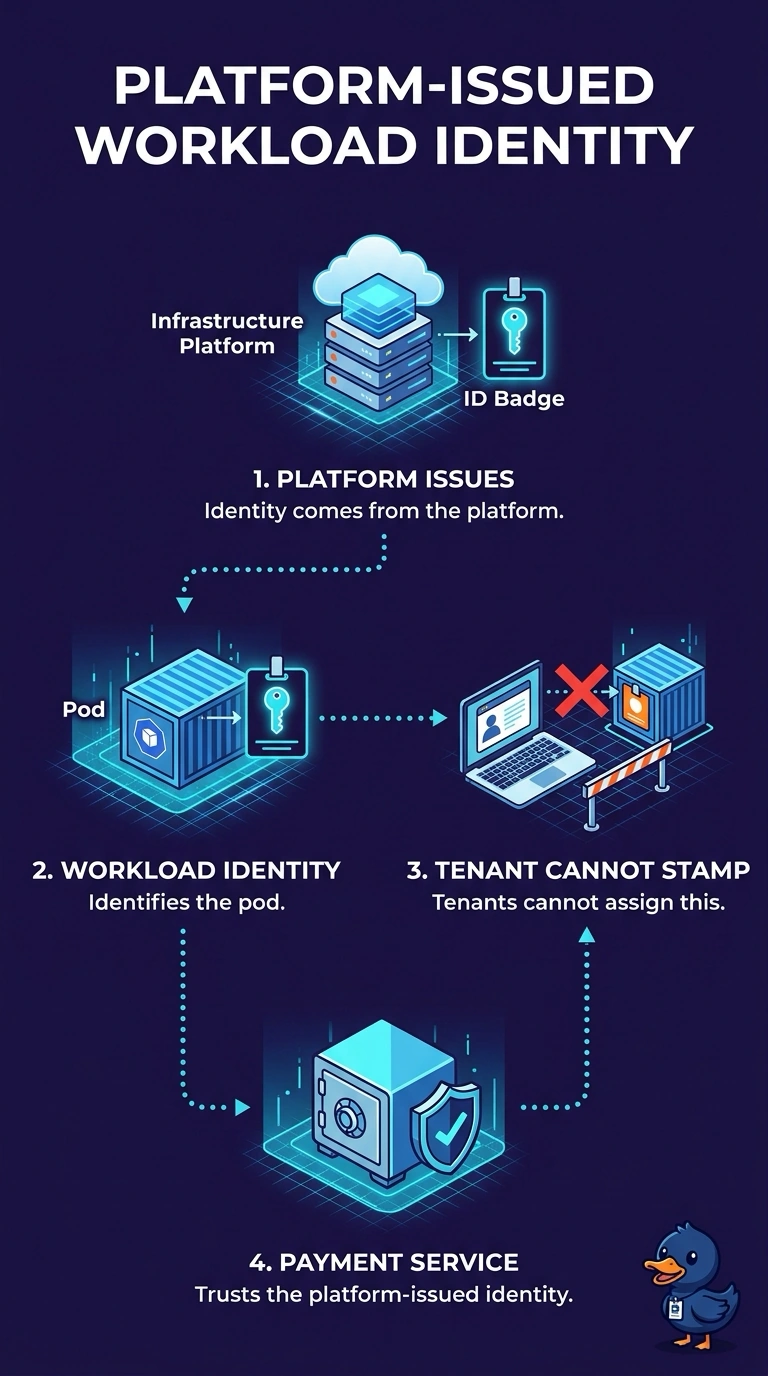
Short Explanation
A name tag you write yourself should not open the vault. You accept payment calls only from a workload identity the platform issues and the tenant cannot stamp on. More self-set labels, a perimeter firewall, or a function security group leaves that stamp in the caller's hands.
Full Explanation
The label is self-asserted, so a tenant can mark any pod as allowed and the payment service will believe it. A platform-issued identity is minted by the platform rather than the tenant, and the payment policy allows only that identity. Extra labels, a perimeter that misses the pod path, and a function security group that does not attach here all leave the tenant holding the stamp. A platform-issued workload identity that tenants cannot stamp onto their own pods is the design that meets this requirement. A longer list of pod labels that each tenant is still allowed to set itself is the wrong fit because more labels still trust a mark the tenant can place on any pod it is allowed to schedule itself. A perimeter firewall that does not see the calls between pods on this host is the wrong fit because the perimeter sits outside the host and does not see the pod-to-pod call into the payment service. A virtual-machine security group aimed at a function with no guest interface is the wrong fit because a function security group has no guest interface to attach to and does not identify these pods. Exam caveat: Require the attested identity at the destination, and test direct and host-network paths against the same policy. Operational check: From a lab pod whose label says payments-ok but whose identity was not issued for payments, confirm the call is refused, then confirm a platform-issued client succeeds.