
A hotel chain's assistant may issue a refund only when a system rule allows it. Guests paste text that tells the assistant to ignore that rule. Which design stops the override from issuing a refund?
Select an answer to reveal the explanation.
Short Explanation
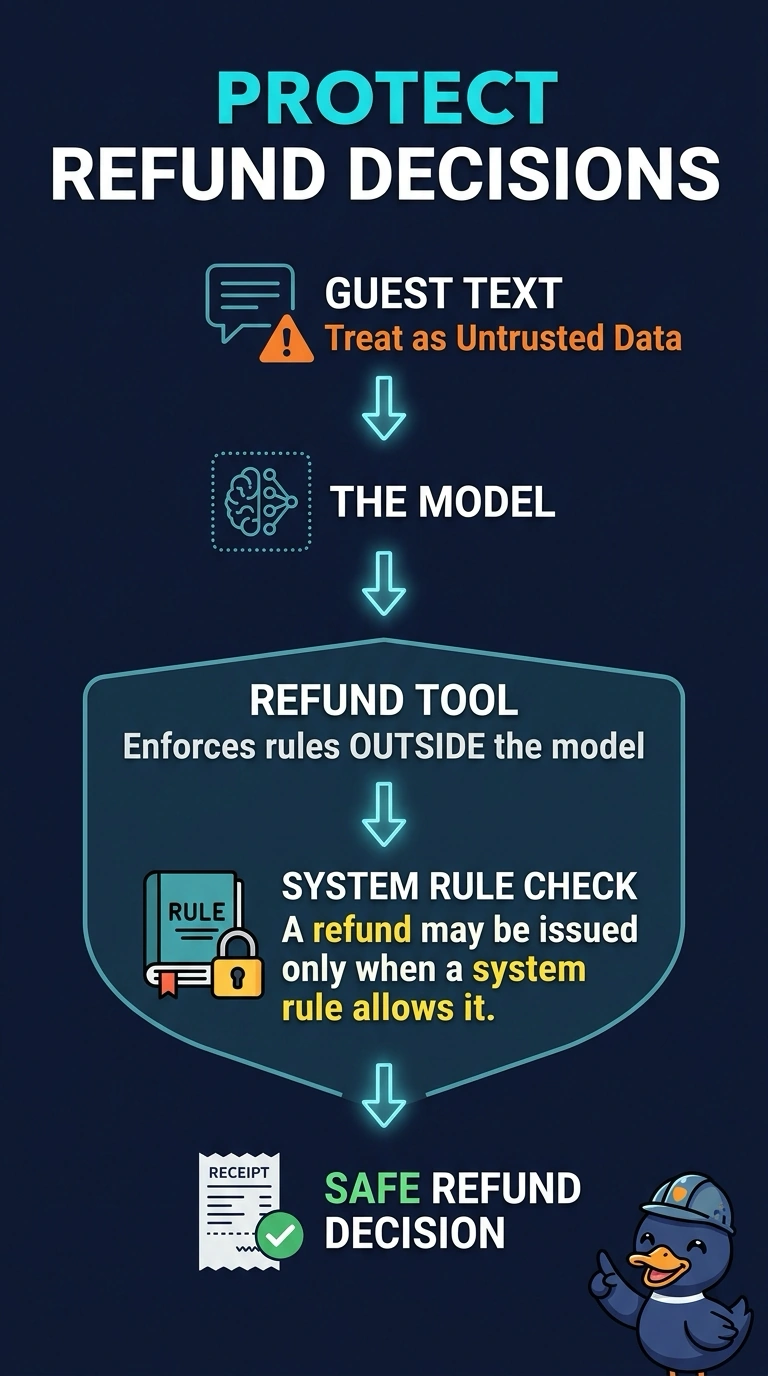
Think of a guest note as a postcard: you don’t let it rewrite the hotel’s rulebook. Treat guest text as untrusted data, and have the refund tool enforce the rule outside the model. Crypto agility for long-lived secrets, review of a separate room-demand forecast model’s training set, and retrieval using an indexer’s broad file access do not stop this refund override.
Full Explanation
Guest text is untrusted data: if the model treats it as an instruction, a guest can try to obtain a refund that the system rule forbids. Keep system instructions separate from guest text, and have the refund tool check the rule outside the model; the tool, not the model’s interpretation of the guest’s request, must control whether a refund is issued. A crypto-agility plan for secrets that must remain confidential for many years addresses long-lived secrecy and changing cryptographic algorithms, not whether the refund tool permits a transaction. Added review of the training set behind a separate room-demand forecast model concerns a different model and data pipeline; it does not determine whether this guest is eligible for a refund. A retrieval index that answers from files using the indexer’s broad access rights creates a retrieval-access concern, but does not enforce the refund rule when the assistant calls the refund tool. Exam caveat: A prompt boundary alone is not sufficient, because the refund decision must be enforced by the tool, where guest text cannot edit the rule. Practical check: In a lab, send a transcript telling the assistant to ignore the rule and refund a stay; confirm that no refund is created and that the tool log shows the rule denied it.