
A university team blocks a public AI website and treats that block as proof that a privately hosted research model has been validated. Which statement is accurate?
Select an answer to reveal the explanation.
Short Explanation
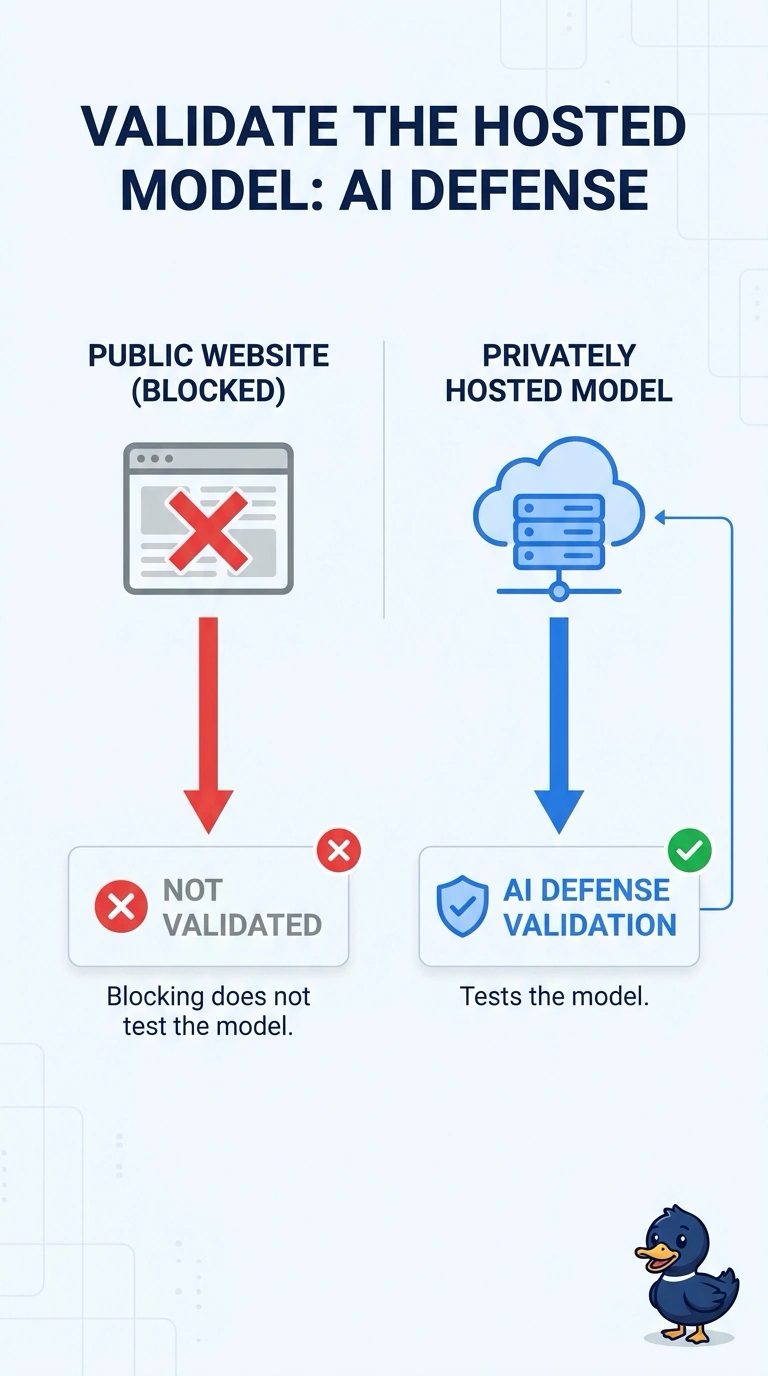
Locking the front gate does not inspect the machine still running in the back room. You still validate the privately hosted model with AI Defense, because a block on a public website does not test that model. The trap is filing the website block as if it were a passed model exam.
Full Explanation
AI Defense validation tests the model the enterprise hosts or fine-tunes. A block on a public chatbot website does not do that work. The privately hosted model still needs AI Defense validation, because blocking a public website does not test that model. The claim that the public-website block validates the private model because campus users can no longer open outside chatbots describes a control on employee browsing, not a test of the research model. The claim that a one-time posture report on the hosting account replaces validation of the privately hosted research model swaps a configuration finding for model validation, and posture is not a malware verdict and not a model test. The claim that disk encryption on the model server finishes validation once the public chatbot website has already been blocked protects stored bytes and still never exercises the model. Exam caveat: a web-category block of a public chatbot does not validate a private model, and validation has to be repeated after a later fine-tune. Operational check: confirm the validation record names the privately hosted model and a current test, not a web-block event from the campus proxy.