
A factory must enforce east-west traffic between application servers and tie each flow to the process that opened it. Which product matches that job?
Select an answer to reveal the explanation.
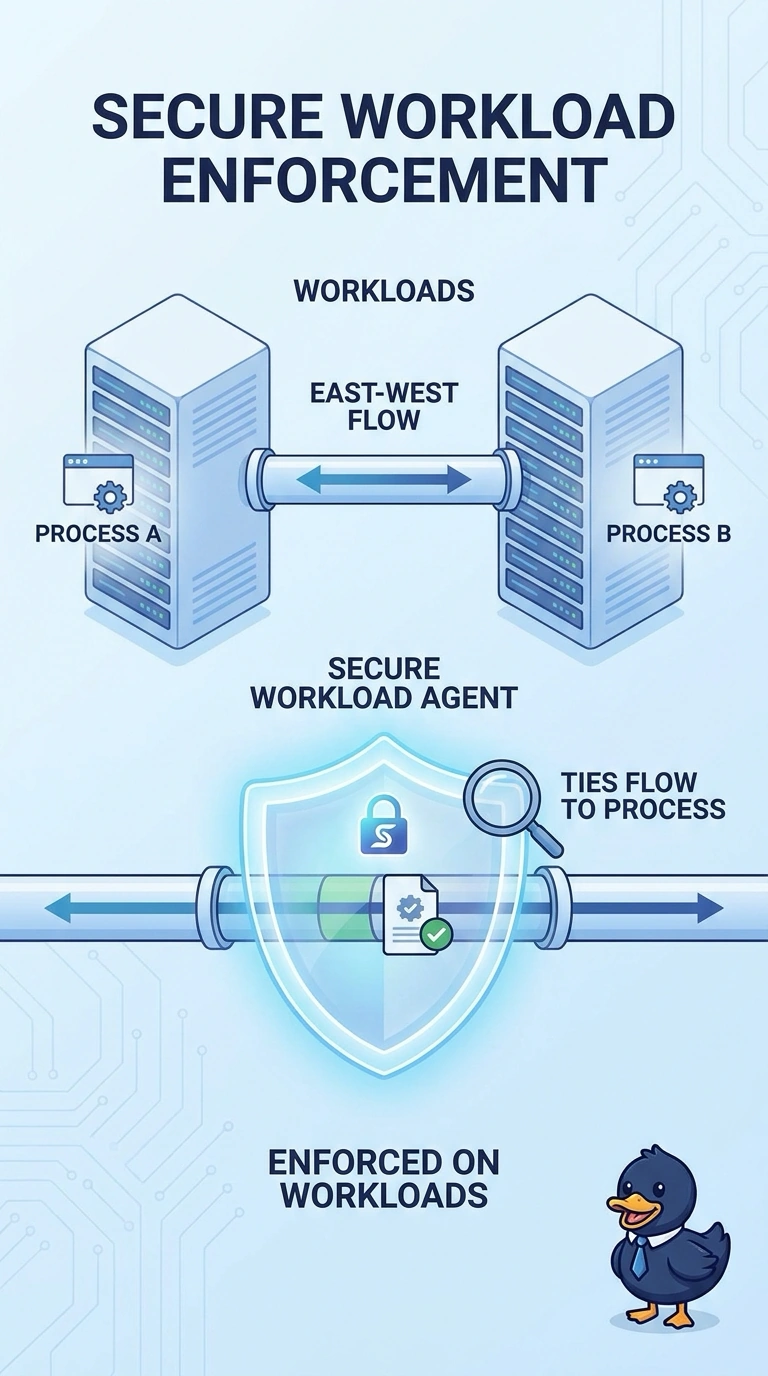
Short Explanation
A door guard watching the public lobby cannot tell you which machine on the factory floor opened a socket. You want Secure Workload, which ties east-west server flows to a process. The secure web gateway is built for user web traffic, not that server path.
Full Explanation
Secure Workload is the product for east-west, process-aware enforcement on servers. A Secure Workload Deep Visibility or Enforcement Agent can associate observed flows with the consuming or providing process. An Enforcement Agent can enforce policy on the host. Using Secure Workload so east-west server flows can be tied to a process and enforced on the workloads matches the factory job. Sending those server-to-server flows through the secure web gateway and applying a user web category rule points a user-web proxy at traffic it is not built to classify as a server process. Relying on DNS security at the plant resolver to name which process opened the socket asks a name lookup to identify a process, which DNS security does not do. Enabling a perimeter intrusion-prevention rule and assuming it sees process-level flows that stay inside the plant expects an edge sensor to observe an internal conversation that never crosses that edge. On the exam, process-aware server enforcement is Secure Workload, and user web policy is the secure web gateway. In operations, confirm the workload agents report the server-to-server conversation with a process identity before enforcement is turned on, so a real dependency is not cut blindly.