
A school counselor working from home has no roaming module, and the browser connects straight to the internet. When does secure web gateway policy apply to that browsing?
Select an answer to reveal the explanation.
Short Explanation
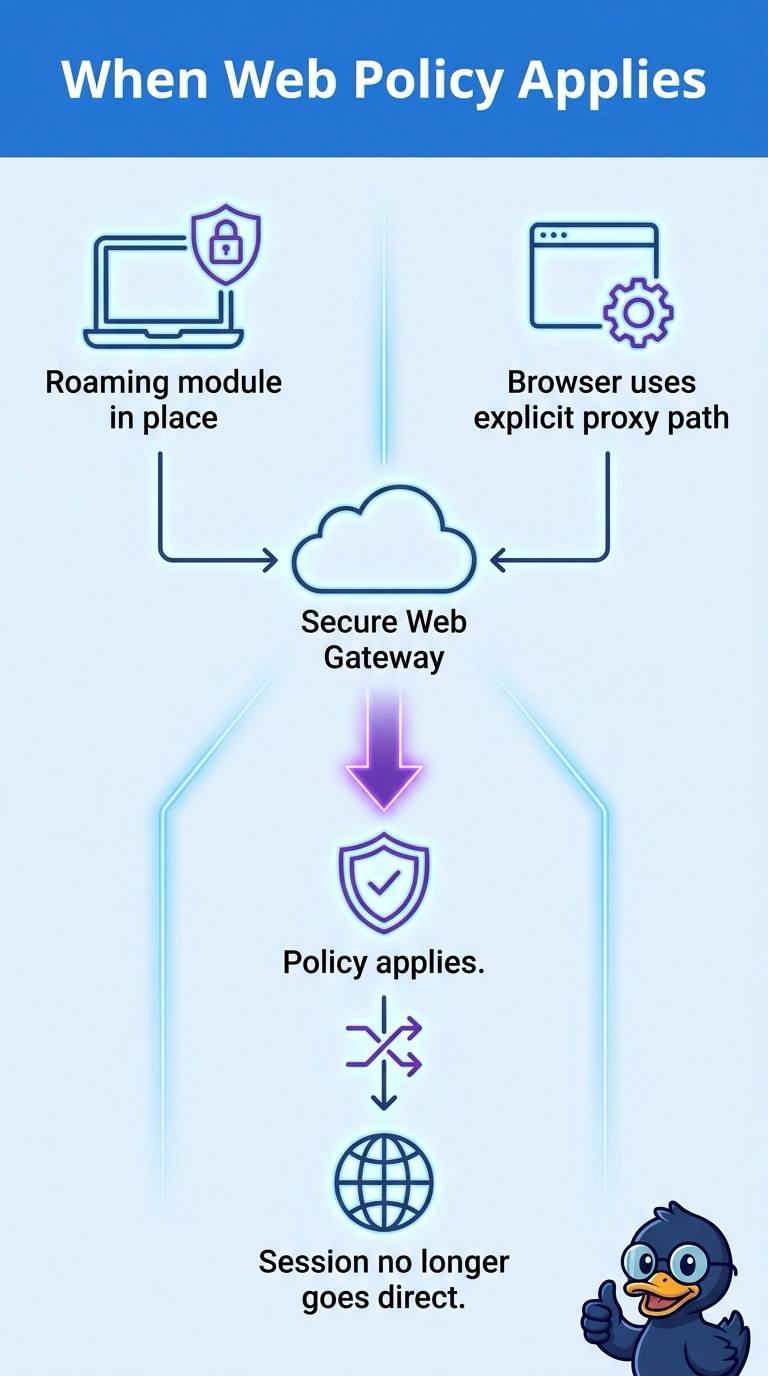
A rule at the school gate does nothing for you if you walk in through the park. Off the network, without the roaming module, this browser goes direct, and web policy applies only once that module or an explicit proxy path is in place. Home DNS alone is not the proxy.
Full Explanation
Web policy applies when the browser is on a path the secure web gateway can see. When the roaming module is in place, or the browser uses an explicit proxy path, so the session no longer goes direct, the gateway policy applies to that browsing. As soon as the laptop leaves campus is too soon, because off-network browsers are not steered through the gateway with no extra component required. Without the roaming module, the counselor goes direct and skips the policy. When the home router uses the school DNS resolver, DNS policy is not the same control as the web gateway. A protected resolver can block a name, and it does not apply category, URL, file, or malware policy. When full-disk encryption is enabled, a passing posture result is not what forces web traffic through the gateway. Posture is endpoint health, not the proxy path. Exam caveat: an off-network user with the roaming module is different from an off-network user without it. Operational check: from the counselor laptop, browse before the roaming module is installed and expect no gateway log, then install the module or set an explicit proxy and expect the session to appear.