
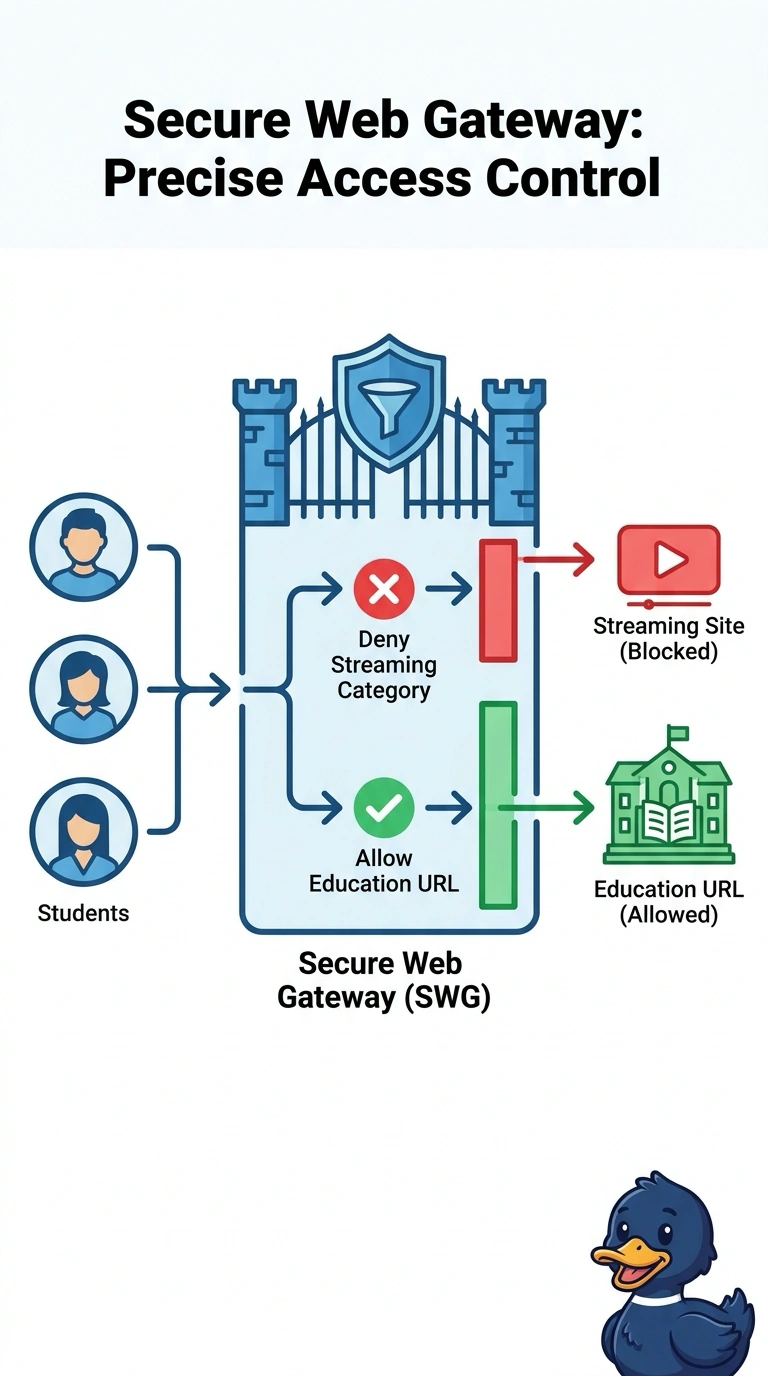
A school must deny a streaming category for students while a specific education URL on a similar site stays available. Which control can enforce both outcomes?
Select an answer to reveal the explanation.
Short Explanation
Think of a door person who can read the exact flyer, not just the name of the street. You use the secure web gateway, because it can enforce the category and still allow that specific education URL. The trap is blocking the parent domain in DNS, which is coarser and takes the education page down with the stream.
Full Explanation
The secure web gateway is the proxy for web traffic and can enforce a category and a full URL. It can deny the streaming category for students and still allow that specific education URL. A DNS block of the parent domain does not keep the education URL up while stopping the streaming category for students, because DNS cannot see the path and a block of the parent name stops both. Encryption at rest on the student laptops protects stored bytes, and it does not hide streaming-category traffic from the school network or choose a URL. An IPsec tunnel from the school to the data center protects a network path, and it does not select the education URL inside the category. The two outcomes have to be tested as separate requests, because one parent-name decision cannot deny the stream and keep the education page at the same time. Exam caveat: a category block stops the sites in that category, and a URL exception is how you keep one education page when the category must stay denied. Operational check: browse the education URL as a student and confirm it loads, then browse a streaming URL in the denied category and confirm it is blocked.