
A bank's network team wants switch logins with per-command authorization and command-level accounting during change windows, while the security team enables 802.1X EAP-TLS on the wireless LAN. Both AAA services will terminate on the same ISE cluster. Which AAA protocol assignment correctly separates device administration from network access?
Select an answer to reveal the explanation.
Short Explanation
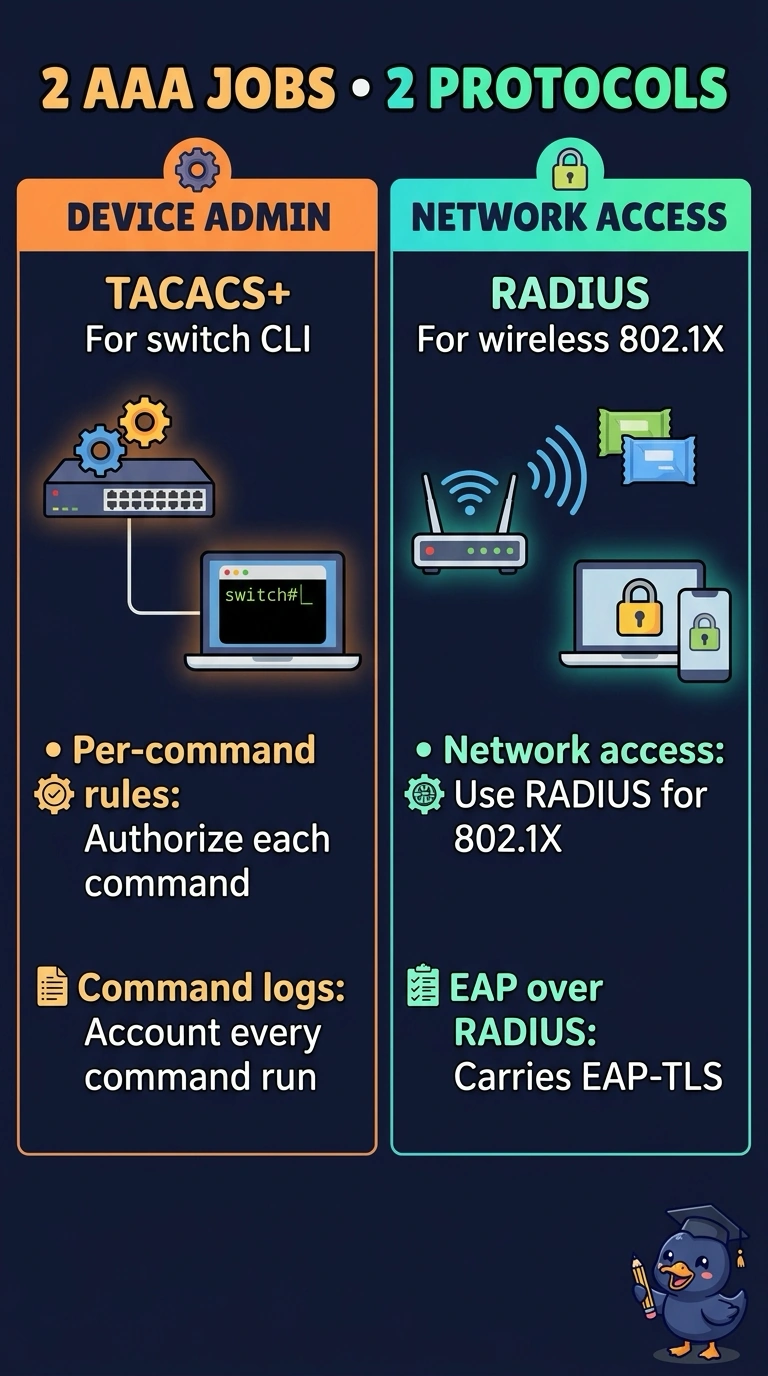
You’re separating the services by what each protocol is suited to carry. Like a workshop log that records every tool you touch, TACACS+ supports per-command authorization and accounting for switch CLI sessions. RADIUS carries EAP for wireless 802.1X, and both services can terminate on the same ISE cluster.
Full Explanation
TACACS+ is appropriate for switch administration because it separates authentication, authorization, and accounting and supports granular command authorization and command-level accounting. RADIUS is appropriate for wireless 802.1X EAP-TLS, and both services can be configured on the same ISE cluster. Using RADIUS for switch per-command authorization with session accounting misses the required command-level audit trail: although some platforms support RADIUS command authorization, session accounting is not command-level accounting. Using TACACS+ for switch CLI commands but RADIUS with PEAP for wireless access changes the required EAP method; the scenario specifies EAP-TLS, even though the protocol assignment otherwise fits. Using TACACS+ for switch CLI commands and RADIUS for wireless EAP-TLS on a separate ISE cluster gets the protocol assignments right but contradicts the shared-cluster design. The fitting configuration is TACACS+ for switch CLI command authorization and accounting, with RADIUS for wireless EAP-TLS on the same ISE cluster. Exam caveat: platform support for RADIUS command authorization and accounting varies, so do not assume RADIUS provides TACACS+-style command accounting. Practical check: verify the ISE policy sets, switch command-accounting records, and wireless authentication logs during a test change window.