
A clinic network runs a central ISE policy service node in the data center, and profiling must classify printers and IP phones across twelve access switches. Both SPAN destination ports on every access switch are already used by the network analyzer, the routed client interfaces on the distribution layer already relay DHCP to a remote server, and the profiler needs DHCP option fingerprints plus the printer HTTP user-agent strings. Which probe and helper design should be configured for the ISE profiler?
Select an answer to reveal the explanation.
Short Explanation
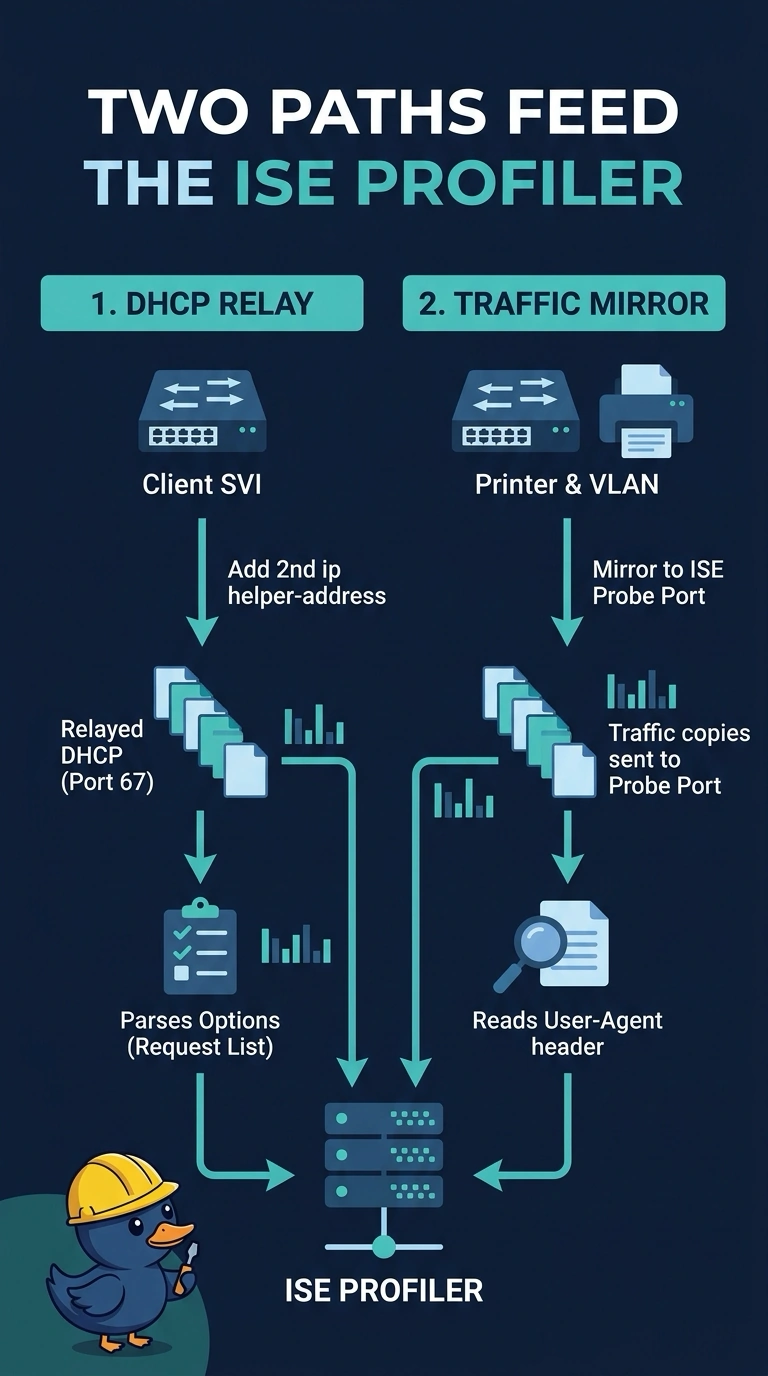
You need two different delivery paths into the profiler here. The DHCP helper carries fingerprint options from every subnet, while the mirror supplies HTTP header text a relay can't deliver. SNMP and NetFlow are solid probes, but neither unpacks a printer's user-agent string.
Full Explanation
The specified design sends DHCP broadcasts to the ISE node through a second helper address on each client SVI, allowing the profiler to inspect DHCP option fingerprints while preserving the existing relay destination. Mirroring printer VLAN traffic from the distribution switch to the ISE probe port supplies the HTTP packets needed to observe printer user-agent strings. Local SPAN is a familiar way to deliver packet traffic to a probe, and the helper configuration would still address DHCP, but the access-switch destination ports are already occupied; it cannot be deployed there without displacing the network analyzer or freeing another port. SNMP polling is commonly used to collect device identity and interface information, but it does not expose HTTP headers or user-agent strings, so it misses the required printer fingerprint even though DHCP delivery is configured. NetFlow version 9 can provide useful flow metadata, but ordinary flow records do not carry the HTTP user-agent header; the helper handles DHCP, yet the design still lacks the required HTTP fingerprint. Exam caveat: distinguish packet-based probes, which can inspect application headers, from flow or management telemetry, which generally cannot. Practical check: verify the ISE node receives relayed DHCP packets and mirrored printer HTTP traffic, and confirm the probe port and SPAN source/VLAN support both on the deployed platform.