
A regional bank piloted ISE as one all-in-one node in its lab. For production, RADIUS and TACACS+ logins must keep working if a single server fails, administrators must keep a usable management console during that outage, and all policy must stay authored from one console. Which ISE deployment option meets all three continuity requirements?
Select an answer to reveal the explanation.
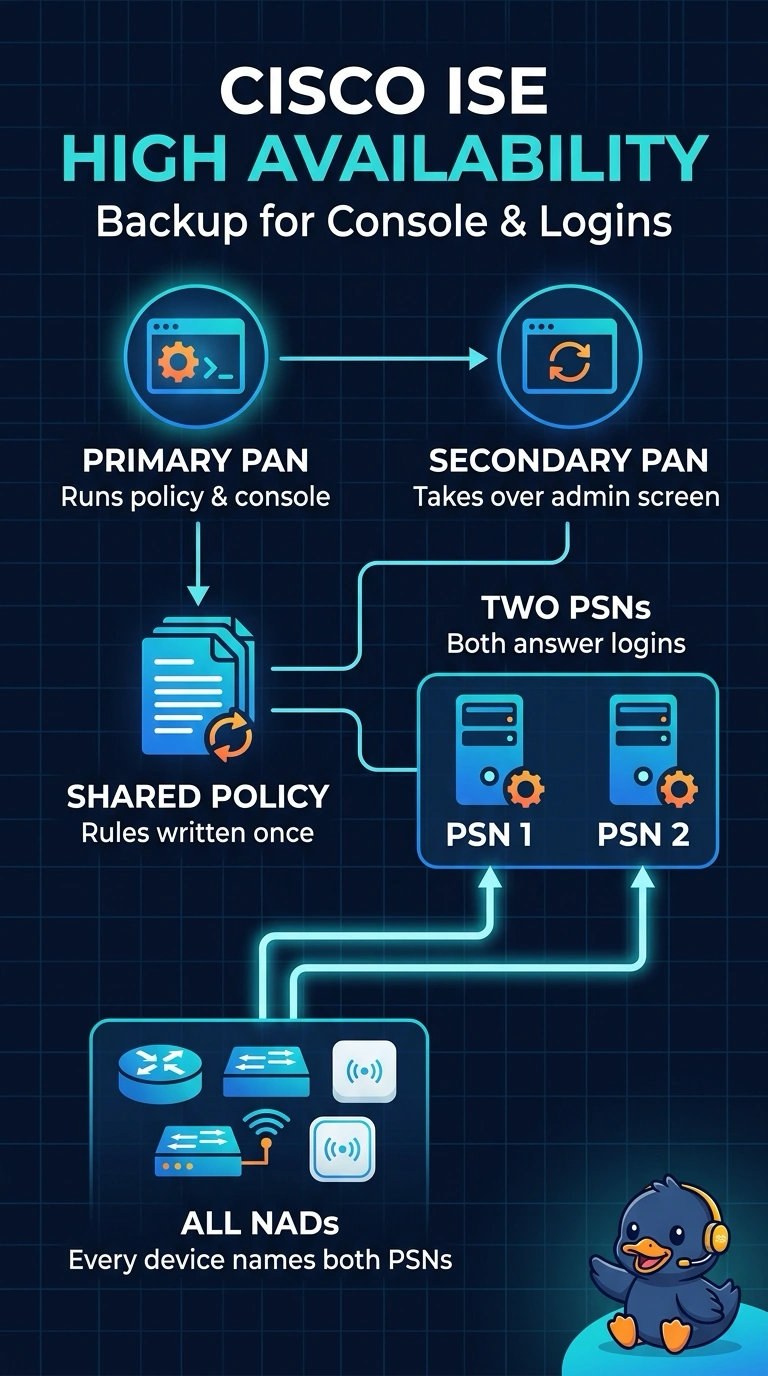
Short Explanation
You split the roles so no single box owns everything: a secondary PAN keeps the console alive and two PSNs both answer logins. It's like keeping a spare key at a second desk instead of one locked control room. Single-node designs buy you only one of those safety nets.
Full Explanation
A distributed ISE deployment separates the personas so no single appliance carries every role: the primary PAN holds policy and configuration, a secondary PAN can take over the administrative console, and PSNs are the nodes that actually terminate RADIUS and TACACS+ sessions. Listing both PSNs on every switch and router means authentication survives the loss of one policy node, while the secondary PAN keeps administrators in the GUI, so all three continuity requirements land in one design. Two separately managed standalone appliances is the appliance-pair approach, and it fails because each box keeps its own policy repository and its own console, so policy has to be authored twice. Adding only a secondary PAN is the management-redundancy approach, and it fails because sessions still terminate on the primary node, so an outage still stops logins. Fronting PSNs with a load balancer behind a single PAN is the RADIUS-failover approach, and it fails because the management console itself remains a single point of failure. Exam caveat: persona counts and consolidation rules change between releases, so learn the separation of roles instead of memorising a maximum node number. Practical check: open each network device entry and confirm both PSNs are listed, then verify the secondary PAN is registered and in sync.