
A logistics warehouse wants visiting drivers to join a guest SSID at a site whose only web server is ISE itself. Each driver enters a name and mobile number on a login page served by ISE, and access must stop after eight hours. Which web authentication design meets these requirements?
Select an answer to reveal the explanation.
Short Explanation
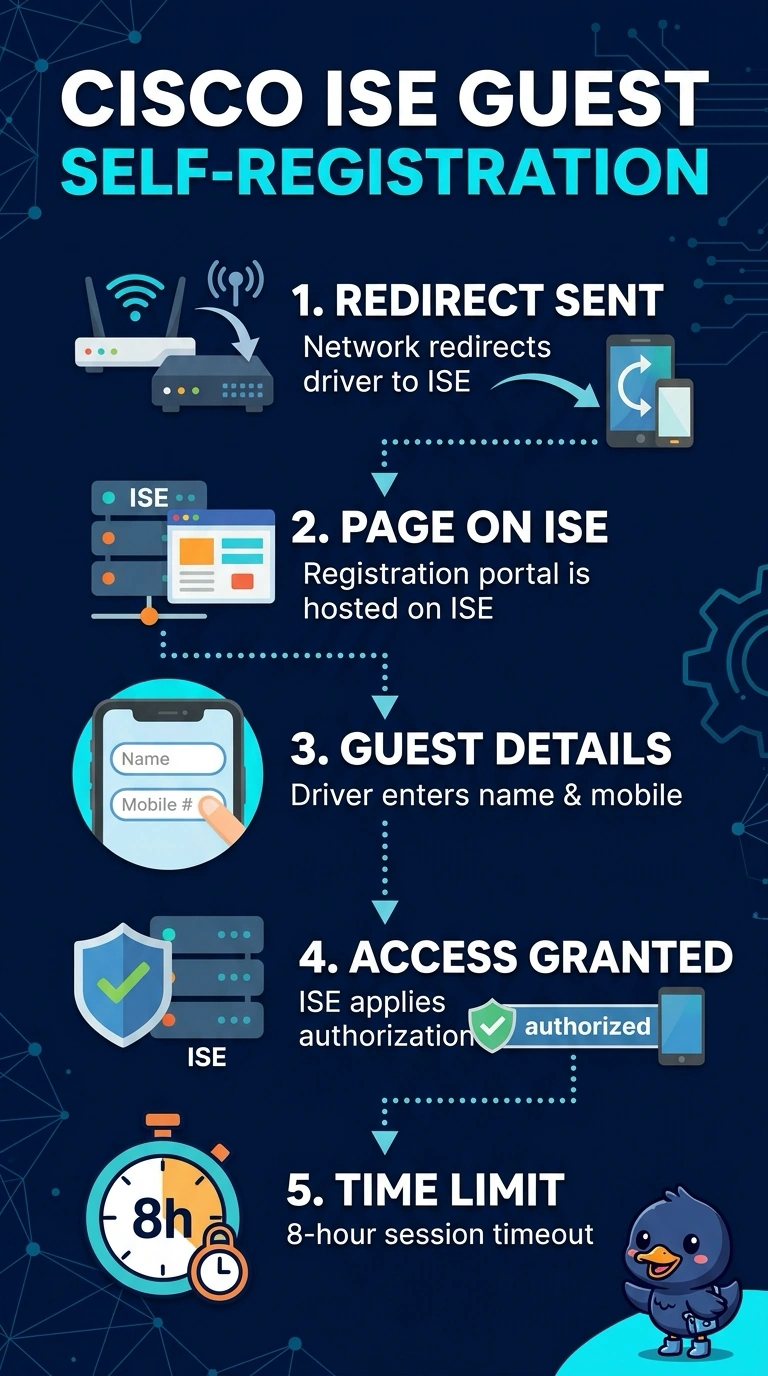
With central web authentication, you can send drivers to ISE’s guest self-registration portal to enter their name and mobile number. Set the session timeout to eight hours, like an access pass that expires at the end of a shift.
Full Explanation
Central web authentication is the best fit because the wireless network redirects the driver to a web authentication flow, while ISE hosts the guest self-registration page, captures the required name and mobile number, and applies the eight-hour session timeout. Controller-hosted local web authentication can collect guest details and enforce a timeout, but it places the login page on the controller rather than on ISE, contrary to the stated server constraint. An ISE-hosted hotspot can provide a captive page and an eight-hour session, but a click-through hotspot that grants access on acceptance does not collect the required name and mobile number. A sponsor-managed guest workflow can use an ISE-hosted portal and an eight-hour session, but staff—not the visiting driver through self-registration—create the account, so it misses the specified enrollment method. Exam caveat: “central” describes where authentication and portal services are provided; it does not by itself guarantee that a particular guest portal collects the requested fields or uses the required registration workflow. In practice, verify the selected ISE portal’s form fields, identity-store and account-provisioning behavior, redirect configuration, and session-timeout enforcement on the wireless policy, then test both a new registration and expiration at eight hours.